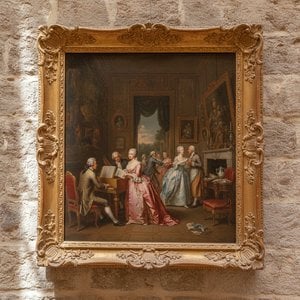
Peter Fendi: A Pioneer of Viennese Biedermeier
Peter Fendi, born in Vienna’s heart on September 4th, 1796, was more than just a painter; he was a pivotal figure in the development of Austrian art during the Biedermeier period. His life, marked by an early physical challenge – a fall from a changing table as an infant that left him with lasting spinal issues – ironically fueled a remarkable talent for drawing and ultimately shaped his artistic vision. His father, a schoolmaster, recognized this innate ability, enrolling young Peter at the prestigious St. Anna’s Academy of Fine Art in 1810. There, under the tutelage of esteemed artists like Johann Martin Fischer, Hubert Maurer, and Johann Baptist von Lampi the Elder, Fendi honed his skills, laying the foundation for a prolific career spanning oil paintings, watercolors, prints, etchings, lithographs, and even wood carving. Fendi’s early professional life began at the Imperial Gallery of Coins and Antiquities in 1818, where he served as a draughtsman and engraver under Joseph Barth, an influential art collector and the personal ophthalmologist to Emperor Joseph II. This position provided invaluable access to artistic circles and exposed him to the meticulous detail demanded by imperial commissions. A significant milestone arrived in 1821 when Fendi received a gold medal for his oil painting *Vilenica*, solidifying his reputation within the Viennese art scene. This recognition led to election as a member of the Academy of Fine Arts Vienna in 1836, further cementing his standing amongst his peers.A Dutch Influence and Venetian Inspiration
Fendi’s artistic style was deeply influenced by two distinct yet complementary sources: the Dutch masters and the Italian Renaissance. The realism and genre scenes prevalent in the works of artists like Adriaen Brouwer, Adriaen van Ostade, and Rembrandt resonated profoundly with Fendi, shaping his depictions of everyday life – bustling marketplaces, tavern scenes, and intimate domestic moments. These paintings are characterized by a keen observation of human behavior, often imbued with a subtle sense of humor or social commentary. Simultaneously, Fendi’s journey to Venice in 1821 proved transformative. Immersed in the opulent art collections of Giovanni Bellini, Tintoretto, Titian, and Paolo Veronese, he absorbed their dramatic compositions, rich colors, and masterful use of light – elements that would later infuse his own work with a sense of grandeur and theatricality.Lithographic Innovation and Portraiture
Beyond traditional painting techniques, Fendi was a true innovator in the field of lithography. His multicolored prints, particularly those produced in the 1830s and 40s, were groundbreaking for their time, demonstrating remarkable technical skill and artistic sensitivity. These prints weren’t merely reproductions; they were independent works of art, often depicting scenes from Viennese life with a vibrant palette and dynamic composition. Furthermore, Fendi was a highly sought-after portraitist, capturing the likenesses of both nobles and commoners alike. His portraits are notable for their psychological depth and ability to convey the personality of his subjects – a testament to his keen eye and understanding of human character. Notably, he engraved a series of five Austrian banknotes issued in 1841, showcasing his versatility as an engraver.Legacy and Artistic Significance
Peter Fendi’s legacy extends far beyond the individual artworks that bear his signature. He played a crucial role in shaping the Biedermeier aesthetic – characterized by its intimate scale, realistic depiction of everyday life, and subtle social commentary. His influence can be seen in the works of subsequent generations of Austrian artists. His meticulous attention to detail, combined with his innovative approach to lithography, cemented his place as one of the most important figures of the Biedermeier period. Today, Fendi’s paintings are preserved in prestigious collections such as the Albertina Museum, the Belvedere Gallery, and the Prince of Liechtenstein's collection in Vaduz, ensuring that his artistic contributions continue to be appreciated and studied for generations to come. His work offers a valuable glimpse into 19th-century Austrian society, capturing both its beauty and its complexities with remarkable skill and sensitivity.Questions & Answers
How many artworks by Peter Fendi are available to browse?
You can browse 23 artworks by Peter Fendi on the All Artworks page.
Is there an overview of all the subjects Peter Fendi painted?
The Subject Atlas page maps Peter Fendi's artworks by subject.
In which historical period did Peter Fendi work?
Peter Fendi worked in the 19th-Century period. The period situates the artist's activity in history.