Paul César Helleu: A Portrait of the Belle Époque
- Born: Vannes, France (1859)
- Died: 1927
Early Life and Artistic Training
Paul César Helleu was born in Vannes, Brittany, France, in 1859. His father, a customs inspector, passed away when Helleu was still a teenager. Despite his mother's initial reservations, he moved to Paris at a young age to pursue his artistic ambitions. He studied at Lycée Chaptal and, at the remarkably young age of sixteen, gained admission to the prestigious École des Beaux-Arts. There, he received formal training under Jean-Léon Gérôme.
Helleu's early exposure to the Impressionist movement during the Second Impressionist Exhibition in 1876 proved pivotal. He was deeply influenced by artists like John Singer Sargent, James McNeill Whistler, and Claude Monet, captivated by their innovative techniques and focus on outdoor scenes—a stark contrast to traditional studio practices.
Development as an Artist: Influences and Techniques
To support himself early in his career, Helleu worked for Théodore Deck’s ceramic workshop, hand-painting decorative plates. This experience honed his technical skills. A significant turning point came with his meeting and mentorship under Giovanni Boldini, a portrait painter known for his bravura style. Boldini's influence significantly shaped Helleu's artistic direction.
A close friendship developed between Helleu and John Singer Sargent, which lasted throughout their lives. Sargent’s encouragement and support were crucial to Helleu’s early career. Helleu's mastery of drypoint etching was a defining characteristic of his work. Introduced to the technique by James Jacques Tissot, he quickly became a virtuoso, employing it with the same dynamism and sophistication as his pastels.
Major Works and Recognition
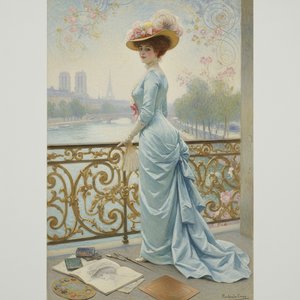
Helleu is best known for his portraits of elegant women from Parisian society during the Belle Époque. Notable subjects included the Duchess of Marlborough, the Marchesa Casati, Belle da Costa Greene, Louise Chéruit, and Helena Rubenstein. His ability to capture their beauty and grace with a refined elegance earned him widespread acclaim.
- Portraits: Helleu’s portraits are celebrated for their delicate lines, subtle color palettes, and the way they convey both physical likeness and personality.
- Drypoint Etchings: His drypoint etchings were particularly popular, allowing for multiple prints to be distributed among friends and family. He produced over 2,000 of these throughout his career.
- Grand Central Terminal Mural: A significant achievement was the commission to create a mural depicting constellations for the ceiling of Grand Central Terminal in New York City. This ambitious project showcased his artistic vision on a grand scale.
Legacy and Historical Significance
Paul César Helleu’s work embodies the spirit of the Belle Époque—a period characterized by optimism, elegance, and artistic innovation. His portraits offer a valuable glimpse into the lives and fashions of Parisian high society during this era.
- Influence on Art: Helleu's innovative use of drypoint etching influenced subsequent generations of printmakers.
- Representation of the Belle Époque: He is considered one of the foremost artists in capturing the essence and aesthetic ideals of the Belle Époque.
- Family Legacy: Notably, he was the father of Jean Helleu and grandfather of Jacques Helleu, both influential artistic directors for Parfums Chanel, demonstrating a lasting family connection to the world of art and design.
Helleu’s work is represented in major museums worldwide, including the Musée d'Orsay and the Louvre in Paris, as well as the Tate in London and the Metropolitan Museum of Art in New York.
Questions & Answers
Is there a chronological account of Paul César Helleu?
Paul César Helleu's career unfolds period by period on the artist's Chronicle page: a horizontal timeline of the artworks, grouped into career-period chapters.
Is there a timeline of Paul César Helleu's works?
Paul César Helleu's artworks can be seen in chronological order on the artist's Artwork Timeline page.
Where is Paul César Helleu from?
Paul César Helleu was born in France.