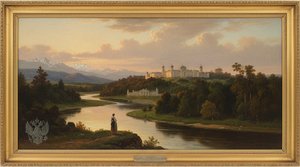
Nikanor Grigorievich Chernetsov: A Visionary of Russian Landscape
Nikanor Grigorievich Chernetsov (1805 – June 8, 1865) stands as a prominent figure in the landscape painting tradition of 19th-century Russia, celebrated for his meticulous observation and ability to convey profound emotion through meticulously rendered scenes of the Russian countryside. Born in Lukh, Russia, Chernetsov’s artistic journey began with a formative education at the Imperial Academy of Arts in Saint Petersburg under Maxim Vorobiev from 1823 to 1827 – an institution that instilled within him the principles of Romanticism and championed realism alongside expressive color palettes. This grounding would prove instrumental in shaping his distinctive style, characterized by painstaking detail and a deep connection to the natural world.
- Early Life & Influences:
- Vorobiev’s Influence: Maxim Vorobiev's teachings emphasized capturing atmospheric conditions and conveying psychological depth—elements that would permeate Chernetsov’s oeuvre.
- Family Background: Chernetsov hailed from a modest family, fostering an appreciation for simplicity and authenticity that mirrored his artistic sensibilities.
Chernetsov embarked on extensive travels throughout Russia, the Caucasus, Crimea, and the Middle East during his formative years. These expeditions served not merely as sources of inspiration but also as invaluable training grounds for honing his sketching skills—skills he subsequently transformed into breathtaking paintings. His canvases depict iconic locations like Kazbek Mountain (shown in “Mountain Landscape”), capturing its grandeur with remarkable accuracy and infused with a palpable sense of majesty. Similarly, scenes from the Volga River – notably "The Volga" – are rendered with subtle tonal gradations that evoke the serenity of the waterway under varying weather conditions.
- Travels & Sketching:
- Kazbek Mountain: Chernetsov’s depiction of Kazbek exemplifies his commitment to capturing geological formations and atmospheric subtleties.
- Volga River Views: The Volga series showcases Chernetsov's mastery in portraying the tranquil beauty of Russian rivers.
Chernetsov’s artistic technique was marked by a dedication to layering glazes—a painstaking process that allowed him to achieve luminous colors and subtle textural variations. He meticulously studied the effects of light on surfaces, striving to reproduce faithfully the nuances of natural illumination. This meticulous approach is particularly evident in “Nevka by the Elagin Island,” where Chernetsov skillfully captures the misty atmosphere surrounding Lake Elagin—a testament to his observational prowess. Furthermore, "Calm Before the Storm" powerfully conveys the drama of impending weather, utilizing bold brushstrokes and contrasting hues to heighten emotional impact.
- Technique & Style:
- Glazing Technique: Chernetsov’s layering of glazes created depth and luminosity in his paintings.
- Atmospheric Rendering: He expertly depicted atmospheric conditions, mirroring the Romantic preoccupation with capturing mood and emotion.
Chernetsov's work gained recognition within Russia’s artistic circles and found its way into prominent museums like the Taganrog Art Museum and the Nizhny Novgorod State Art Museum. His legacy extends beyond his individual paintings; he served as a teacher at Saint Petersburg Academy of Arts, nurturing the talents of future generations of artists. Chernetsov's contribution to Russian landscape art solidified his place among the foremost Romantic painters of his time—a painter who successfully blended scientific observation with artistic expression, resulting in images that continue to inspire awe and admiration today.