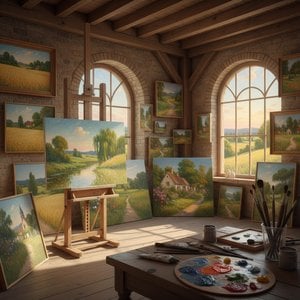
Early Life and Artistic Awakening
Nicolas Alexandrovich Tarkhoff, born in Moscow on January 20, 1871, emerged from a family of prosperous merchants—a background that initially seemed destined for commerce rather than canvas. However, the young Tarkhoff possessed an innate artistic inclination, described as a “fervent desire to be a painter.” Tragedy marked his childhood; he lost his mother at age three and his father eight years later, experiences that perhaps fostered a sensitivity reflected in his later work. Despite this early loss, his passion for art persisted, though it faced initial resistance from his family who favored more conventional paths. He briefly fulfilled military obligations before finding employment with the Brest-Litovsk Railways—a period of deferment before fully embracing his artistic calling. In 1894, he bravely attempted entry into the School of Painting, Sculpture and Architecture in Moscow, but was rejected due to what was perceived as a “revolutionary temperament.” This rejection didn’t deter him; instead, it propelled him towards Konstantin Korovin's studio in 1897, where he found mentorship within Moscow’s vibrant artistic circles.Parisian Influences and the Embrace of Post-Impressionism
The late 1890s witnessed a pivotal shift as Tarkhoff journeyed to Paris, a city already pulsating with avant-garde energy. He initially settled in Munich before permanently relocating to the French capital in November 1898. Paris offered not just a change of scenery but an immersion into a world brimming with artistic innovation. Though he enrolled at the Académie Julian under Jean-Paul Laurens, his independent spirit soon led him away from strict academic constraints. He also studied with Luc-Olivier Merson, yet it was the works of Van Gogh, Gauguin, and Cézanne that truly ignited his artistic evolution. These masters revealed “hidden talents” and charted a new course for Tarkhoff’s style—one characterized by expressive brushstrokes, bold color palettes, and an exploration of subjective experience. He quickly absorbed the lessons of Impressionism but moved beyond its purely optical concerns, embracing a more emotionally charged approach that would define his Post-Impressionist identity.Themes and Techniques: Capturing Light and Emotion
Tarkhoff’s oeuvre is remarkably diverse, encompassing landscapes, genre scenes, still lifes, and portraits. However, certain themes consistently emerge—the bustling life of Paris, the tranquility of rural settings, and intimate moments of family connection. His Parisian paintings capture the energy of boulevards, carnivals, and racing cabs, while his later works reflect a settled life in Orsay, where he resided with his family from 1911. He masterfully employed oil paint to convey not just visual reality but also atmosphere and feeling. Textured brushwork became a hallmark of his style, creating surfaces that shimmered with light and movement. He wasn’t merely depicting scenes; he was translating emotions onto canvas. His use of color was equally significant—vibrant hues were often juxtaposed to create dynamic contrasts and evoke specific moods. Works like “Goats in the Sunshine” exemplify this approach, showcasing a rural idyll bathed in warm light and imbued with a sense of peacefulness. “My Family,” painted during his Russian Post-Impressionist period, reveals a heartwarming tenderness through its expressive style and careful attention to detail.Recognition and Legacy
Nicolas Tarkhoff achieved considerable recognition during his lifetime, participating in numerous exhibitions across Europe. His work resonated with audiences who appreciated his unique blend of Impressionistic techniques and Post-Impressionist sensibilities. He exhibited at La Libre Esthétique in Paris, showcasing pieces like “Un Jour de neige” and “Notre-Dame,” alongside other prominent artists. Although not as widely celebrated as some of his contemporaries, Tarkhoff’s paintings continue to captivate viewers with their evocative power and emotional depth. His work is represented in various collections, including the Musée du Petit Palais, ensuring that his artistic vision endures for future generations. He stands as a testament to the enduring appeal of Post-Impressionism—a style that prioritized subjective experience and paved the way for modern art movements. His ability to capture serene moments and natural beauty through a unique artistic lens solidifies his place within the rich tapestry of early 20th-century Expressionism, offering a compelling glimpse into the heart and soul of an artist deeply connected to both the world around him and the emotions within.Questions & Answers
In which historical period did Nicolas Tarkhoff work?
Nicolas Tarkhoff worked in the Modern period. The period situates the artist's activity in history.
Where are Nicolas Tarkhoff's artworks grouped by art movement?
The movements Nicolas Tarkhoff worked in can be seen on the artist's All Movements page, which groups the artworks by movement.
Where can I find statistics about Nicolas Tarkhoff's works?
A Stats page exists for Nicolas Tarkhoff, presenting statistics about the artist's artworks on this website.