Early Life and Artistic Foundations
Neil Gavin Welliver, born in the small lumber town of Millville, Pennsylvania, on July 22, 1929, embarked on a journey that would establish him as a pivotal figure in American landscape painting. His upbringing amidst the rugged beauty of rural Pennsylvania instilled within him a deep connection to nature—a reverence that would become the defining characteristic of his artistic vision. After graduating from high school with a small class of twenty-one students, Welliver pursued formal training at the Philadelphia College of Art (now part of the University of the Arts), laying the groundwork for his future explorations in visual expression. He continued his studies at Yale University, earning an MFA and encountering influential abstract artists like Burgoyne Diller and Josef Albers. These early encounters with abstraction proved formative, shaping Welliver’s understanding of color theory and composition—principles that would subtly inform his later representational work.
From Abstraction to the Maine Wilderness
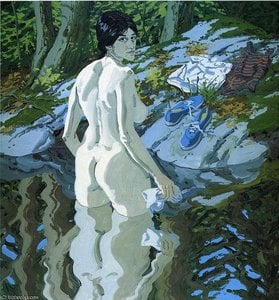
Welliver's artistic trajectory wasn’t a straight line but rather an evolving process of discovery. Initially drawn to abstract color field painting, he began teaching at Cooper Union in 1953 and then at Yale from 1956 to 1966. However, a pivotal shift occurred during his time in Maine—a state that would become synonymous with his artistic identity. In the early 1960s, Welliver ventured into the remote woodlands of Maine, abandoning the confines of abstraction for the direct observation of nature. He began painting figures outdoors, often depicting his sons canoeing or female nudes bathing in the pristine waters and rugged landscapes. These works were characterized by a sense of intimacy and immediacy, capturing fleeting moments of human connection with the natural world.
The Large-Scale Landscapes: A Unique Approach
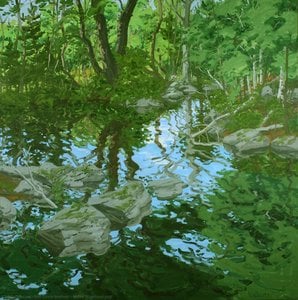
By the mid-1970s, Welliver’s focus narrowed exclusively to landscape. He wasn't interested in idyllic depictions; instead, he sought to capture the raw, untamed essence of the Maine wilderness. His mature paintings—often monumental in scale, reaching dimensions of 8 by 10 feet—are remarkable for their dual nature: they are simultaneously richly painted abstractions and clear representational images. He carried his equipment on his back, a hefty 70-pound pack containing eight essential oil colors: white, ivory black, cadmium red scarlet, manganese blue, ultramarine blue, lemon yellow, cadmium yellow, and talens green light. These plein-air studies were arduous undertakings, requiring approximately nine hours of focused work in three-hour increments to account for the shifting light conditions. Welliver wasn’t striving for exact replication; he sought “a color that makes it look like it is, again, surrounded by air.” He embraced the challenges of painting outdoors even in winter, relishing the crystal clarity and luminosity created by snow but acknowledging the physical discomfort involved.
Narrative Style and Lasting Legacy
Welliver’s paintings are not merely depictions of landscapes; they are imbued with a sense of narrative—a quiet storytelling that invites viewers to immerse themselves in the scene. He meticulously translated his plein-air sketches into large studio canvases, dedicating 4 to 7 hours each day to the process, starting in the upper left corner and methodically working towards the lower right. The resulting works possess an “emotional intensity that goes beyond the ordinary limits of realism,” yet they also carry a somber quality—a reflection perhaps of the solitude and challenges inherent in his artistic pursuit. His work often features rocky hills, beaver houses, tree stumps, and rushing water, occasionally opening out to expansive blue skies. Welliver’s influence extends beyond painting; he was a dedicated educator, serving as chairman of the University of Pennsylvania Graduate School of Fine Art from 1966 until his retirement in 1989.
Recognition and Historical Significance
Neil Gavin Welliver passed away on April 5, 2005, near his home in Lincolnville, Maine, leaving behind a rich artistic legacy. His paintings are held in esteemed collections worldwide, including the Metropolitan Museum of Art, the Whitney Museum of American Art, the Boston Museum of Fine Arts, and the Hirshhorn Museum and Sculpture Garden. He is remembered as a master of American realism—an artist who redefined landscape painting through his unique approach to color, composition, and narrative. His son, Titus Welliver, also achieved prominence, though as an actor, demonstrating a continuation of artistic talent within the family. Welliver’s work continues to resonate with audiences today, offering a powerful testament to the enduring beauty and emotional depth of the natural world.
Questions & Answers
How popular are Neil Gavin Welliver's artworks?
A Stats page exists for Neil Gavin Welliver, presenting statistics about the artist's artworks on this website.
How many artworks by Neil Gavin Welliver are available to browse?
You can browse 109 artworks by Neil Gavin Welliver on the All Artworks page.
Is there an overview of all the subjects Neil Gavin Welliver painted?
The Subject Atlas page maps Neil Gavin Welliver's artworks by subject.