Momokawa Shikō: Echoes of Edo in Ink and Color
Momokawa Shikō, a name often whispered alongside the vibrant legacy of his master, Eishōsai Chōki, remains a captivating figure within the pantheon of late Edo-period Japanese artists. Born into a world steeped in tradition yet yearning for artistic innovation, Shikō’s career unfolded during a period of profound social and cultural transformation – a time when the fleeting beauty of the courtesan class captivated the imagination and found expression through the exquisite medium of *ukiyo-e* woodblock prints. While his life remains shrouded in relative obscurity compared to contemporaries like Utamaro and Chikanobu, Shikō’s contribution lies not in grand narratives but in the subtle elegance and poignant observations he captured within his meticulously rendered scenes. He was a student, and arguably an adopted son, of Toriyama Sekien, a pivotal figure who revolutionized *ukiyo-e* with his pioneering use of perspective and realism, and whose influence can be clearly discerned in Shikō’s work.
The World of the Courtesan: A Subject Defined
Shikō's artistic focus centered almost exclusively on the world of the *bijin-ga* – paintings and prints depicting beautiful women. This wasn’t merely a fashionable subject; it represented a complex social commentary, reflecting the changing roles and status of women within Edo society. The courtesans, or *yūjo*, occupied a unique position, navigating a delicate balance between pleasure, artistry, and societal constraints. Shikō's depictions weren't simply idealized portraits; they were imbued with an awareness of their subject’s lives – their elaborate hairstyles, the intricate details of their clothing, the subtle expressions that hinted at both vulnerability and resilience. He frequently portrayed them in intimate settings—at their residences, engaging in everyday activities like playing musical instruments or receiving visitors—offering glimpses into a world largely hidden from public view. His prints often featured atmospheric backgrounds, skillfully rendered to complement the figures and evoke specific moods – serene contemplation, playful amusement, or quiet melancholy.
Technique and Style: Echoes of Masters
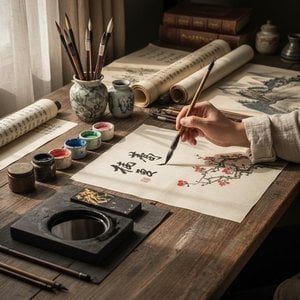
Shikō’s artistic style is characterized by a remarkable sensitivity to detail and a masterful command of *sumi-e* techniques—the art of ink wash painting. He employed delicate washes of black ink, layered with subtle gradations of tone, to create a sense of depth and luminosity. His use of mica powder – a technique borrowed from the renowned artist Kiyonaga – added an ethereal shimmer to certain prints, particularly those depicting nighttime scenes or figures adorned in luxurious fabrics. While undeniably influenced by his master’s approach, Shikō developed a distinct voice within this shared aesthetic. He favored softer lines and more subdued colors than Kiyonaga, creating a mood of quiet intimacy and understated elegance. His compositions often featured asymmetrical arrangements and unconventional perspectives, reflecting a willingness to experiment with the established conventions of *ukiyo-e*. The placement of figures near the margins, as noted by Laurence Binyon, was a deliberate stylistic choice that further emphasized their presence within the frame.
Key Works and Notable Series
Among Shikō’s most celebrated works is undoubtedly “Parading Courtesan” (also known as “The Courtesan Tsuruno-o of the Tsuruya Brothel with her Attendants”), a captivating image that exemplifies his artistic sensibilities. The print captures a moment of graceful movement, as the courtesan adjusts one of the elaborate hairpins securing her *hyōgo-mage* hairstyle – a style characterized by tightly bound buns and adorned with an array of precious ornaments. The composition is meticulously balanced, drawing the viewer’s eye to the central figure while simultaneously conveying a sense of atmosphere and depth through the use of subtle shading and atmospheric perspective. Beyond “Parading Courtesan,” Shikō contributed significantly to several notable series, including depictions of the Eight Views of Lake Ōmi and the Eight Views of the Treasury of Loyal Retainers – projects that showcased his versatility and technical skill.
Legacy and Historical Significance
Momokawa Shikō’s legacy is often overshadowed by the more flamboyant styles of his contemporaries, yet his work holds a unique place within the history of *ukiyo-e*. He represents a crucial link between the artistic innovations of Toriyama Sekien and the subsequent developments in Japanese printmaking. His focus on the courtesan class provided valuable insights into the social dynamics and cultural values of Edo society, while his masterful technique and subtle aesthetic sensibilities continue to resonate with viewers today. While he may not have achieved widespread fame during his lifetime, Shikō’s contributions—particularly his evocative portrayals of beauty and grace—stand as a testament to the enduring power of Japanese art. His work serves as a poignant reminder that even in the shadows of more celebrated artists, quiet brilliance can leave an indelible mark on the world.