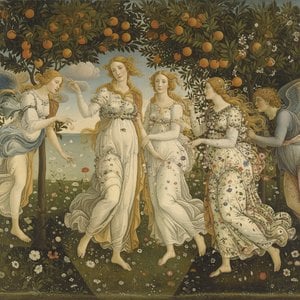
The Enigmatic Master of San Lucchese
The identity of the “Master of San Lucchese” remains elusive, a frustrating puzzle for art historians who recognize his distinctive style—a blend of Florentine idealism and Venetian realism—found in several altarpieces dating back to the mid-14th century. Though his name has been assigned posthumously after a magnificent panel depicting the Coronation of the Virgin housed in the San Francisco Museum of Modern Art, little is known about his life beyond fragmentary evidence suggesting he was active between approximately 1350 and 1420.
His artistic lineage appears to trace back to Maso di Banco, a prominent Florentine painter who championed a humanist aesthetic. This influence is palpable in the meticulous detail of his compositions—particularly evident in works like “Coronation of the Virgin,” where vibrant colors and dramatic lighting capture the solemn grandeur of the biblical scene.
The Master’s oeuvre comprises around 30 paintings, predominantly devotional subjects – altarpieces featuring depictions of saints and Marian figures. These canvases showcase a remarkable command of technique, utilizing tempera paint on panel—a medium favored by artists across Italy during this period—and incorporating gilded leaf to enhance the visual impact.
Notable Works
- Madonna and Child with Saints: This iconic painting exemplifies his signature style, characterized by serene beauty and symbolic richness. The composition is carefully balanced, reflecting a humanist sensibility that sought to elevate spiritual contemplation.
- Coronation of the Virgin: As mentioned previously, this monumental altarpiece demonstrates masterful use of color and perspective—techniques honed during his formative years in Florence under Maso di Banco’s tutelage.
Style and Technique
The Master's artistic style is distinguished by its harmonious blend of Florentine idealism and Venetian realism. He skillfully employed tempera paint on panel, achieving luminous colors and subtle gradations—a hallmark of Venetian painting at the time. Furthermore, he incorporated gilded leaf to imbue his artworks with a sense of majesty and spiritual significance.
His meticulous attention to detail—particularly evident in depictions of drapery folds and facial expressions—reveals an unwavering commitment to portraying human emotion with accuracy and sensitivity. This stylistic approach aligns closely with the broader artistic trends of the Florentine Renaissance, where artists strove to capture both physical beauty and spiritual truth.
Historical Significance
Despite the lack of biographical information, the Master of San Lucchese’s paintings hold considerable historical importance as representatives of a pivotal moment in Italian art history. They embody the humanist ideals that permeated Florentine culture during the mid-14th century—a period marked by intellectual ferment and artistic innovation.
His works stand alongside those of other prominent artists of his era, contributing to the rich tapestry of visual culture that shaped Europe’s cultural landscape. The enduring fascination with “Madonna and Child with Saints” testifies to the timeless appeal of devotional art—a genre that continues to inspire admiration and contemplation centuries later.