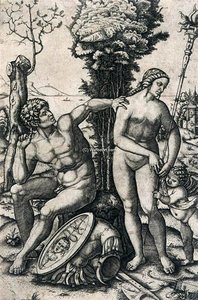
Marcantonio Raimondi: The Florentine Echo in Venetian Printmaking
Marcantonio Raimondi (c. 1480 – c. 1534) stands as a pivotal figure in the burgeoning world of Renaissance printmaking, particularly celebrated for his masterful depictions of mythological narratives and Raphael’s compositions. Born in Arzignano, Italy, Raimondi's artistic journey unfolded against the backdrop of a period marked by intense intellectual exchange between Florence and Venice – exchanges that profoundly shaped his stylistic sensibilities and technical prowess. While biographical details remain scarce, scholarly consensus points to him as one of the earliest printmakers whose oeuvre demonstrates a sustained engagement with innovative engraving techniques and a deep appreciation for the aesthetic ideals championed by contemporaries like Albrecht Dürer.
- Early Life & Training: Precise information regarding Raimondi’s formative years is elusive, yet he emerged from Arzignano as a skilled craftsman—likely trained in niello engraving, a technique involving inlaying precious metals into engraved metal surfaces—a practice that has been debated by art historians like Arthur Mayger Hind.
- The Florentine Influence: Raimondi’s artistic development was undeniably influenced by the vibrant Florentine printmaking scene of his time. He absorbed stylistic elements from artists such as Francia and Andrea Mantegna, mirroring the humanist spirit prevalent in Florence during Raphael's ascendancy.
- Dürer’s Legacy & Technique: The arrival of Albrecht Dürer in Bologna in 1506 served as a catalyst for Raimondi’s artistic evolution. Dürer’s groundbreaking engravings captivated Italian printmakers, prompting them to emulate his meticulous draughtsmanship and pioneering use of tonal shading—a technique that Raimondi skillfully adopted into his own prints.
A Flourishing Career: Engravings from 1505-1511
Between 1505 and 1511, Raimondi produced approximately eighty engravings, showcasing an astonishing breadth of subject matter—ranging from classical mythology to biblical scenes and portraits of prominent figures. His early works demonstrate a remarkable fusion of Florentine and Venetian artistic traditions, reflecting the dynamic cultural landscape of the era. Notably, he meticulously studied Dürer’s prints, particularly “Adam and Eve,” incorporating elements of Dürer's compositional approach and tonal rendering into his own engravings. This collaborative spirit extended beyond stylistic imitation; Raimondi actively engaged in discussions with Michelangelo and Dürer themselves, fostering a vibrant intellectual environment that fueled artistic innovation.
- Mythological Narratives: Raimondi’s engravings frequently revisited classical myths—such as “Pyramus and Thisbe” and “Jason and Medea”—transforming them into visually arresting narratives imbued with symbolic resonance.
- Religious Imagery: He produced numerous prints depicting scenes from the Bible, demonstrating a profound understanding of Christian iconography and artistic conventions.
Copying Dürer & The Venetian Copyright Debate
Raimondi’s unwavering dedication to mastering Dürer's technique extended beyond stylistic emulation; he undertook ambitious projects replicating Dürer’s monumental woodcut series, “The Life of the Virgin,” a practice commonplace among printmakers at the time. However, Raimondi’s endeavors distinguished him from many of his peers by securing legal protection for his original compositions—a landmark case in the nascent history of intellectual property law that challenged prevailing notions regarding artistic authorship and copyright. The Venetian government recognized Dürer's monogram as protected intellectual property, establishing a precedent for safeguarding artists’ rights against unauthorized reproductions.
Concluding Significance: Raimondi’s Enduring Influence
Marcantonio Raimondi’s contribution to Renaissance printmaking transcends mere stylistic imitation; he embodies the spirit of artistic innovation and collaborative inquiry that characterized the era. His engravings continue to inspire admiration for their technical brilliance, compositional sophistication, and evocative portrayal of human experience—solidifying his place as one of the foremost printmakers of his time and a crucial link between Florentine humanist ideals and Venetian artistic dynamism. He remains an exemplar of how artists can engage with the legacy of their predecessors while forging their own distinctive artistic voice.