A Legacy of Thread and Texture
Libby Reinking Lehman stands as a monumental figure in the world of contemporary textile art, recognized globally for her ability to transform the traditional medium of quilting into a profound language of emotion and complexity. Born in Houston, United States of America, she cultivated a career spanning four decades, during which she became much more than a maker of quilts; she was a visionary educator and an international authority on the intricate possibilities of machine artistry. Her work is characterized by an extraordinary mastery of thread and a deep understanding of machine mechanics, allowing her to push the boundaries of what can be achieved through needle and fabric.
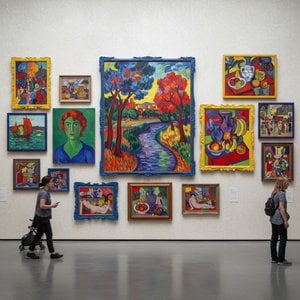
Her artistic approach often bridged the gap between meticulous craft and conceptual depth. In works such as Escapade, created in 1993, Lehman utilized a vibrant, almost dizzying array of colors and patterns to explore themes of memory and identity. Through the careful selection of diverse fabrics—ranging from cotton to perhaps silk or velvet—she constructed rich, textural landscapes where blues, reds, yellows, and greens dance together. These pieces were not merely decorative; they served as fragmented narratives, where each meticulously stitched element acted as a piece of a larger, unresolved story, mirroring the way human recollections are pieced together from disparate sensory experiences.
Innovation and Influence
Lehman’s significance in the quilting community is underscored by her role as a trendsetter and mentor. As a TQS Legend, she was celebrated for her ability to introduce original techniques that moved the medium toward contemporary fine art. Her technical prowess was particularly evident in her use of threads and machine applique, which set her apart from her contemporaries. This dedication to innovation earned her prestigious recognition, including the distinction of having her quilt Joy Ride chosen as one of the 100 Best Quilts of the Twentieth Century.
Beyond her individual creations, her impact was felt through her global teaching career and her contributions to the literature of the craft. She was a beloved author and a lecturer who traveled the world, encouraging fledgling professionals and shaping the next generation of textile artists. Her life’s work remains a testament to the power of handcraftsmanship and the ability of an artist to imbue even the most traditional materials with a personal, indelible touch.
Questions & Answers
What are the birth city and country of Libby Reinking Lehman?
Libby Reinking Lehman was born in Houston, in United States of America.
How do I find works by Libby Reinking Lehman in a specific palette?
Libby Reinking Lehman's works can be browsed by color palette on the artist's By Palettes page.
Where is Libby Reinking Lehman from?
Libby Reinking Lehman was born in United States of America.
What are the birthplace and birth year of Libby Reinking Lehman?
Libby Reinking Lehman was born in Houston in 1953.
Is there a chronological account of Libby Reinking Lehman?
A chronological account of Libby Reinking Lehman's work is available on the artist's Chronicle page, where the artworks pass in order of creation, chapter by chapter.
Can I browse Libby Reinking Lehman's works by movement?
The All Movements page groups Libby Reinking Lehman's artworks by art movement.
In which historical period did Libby Reinking Lehman work?
Libby Reinking Lehman worked in the Contemporary period. The period situates the artist's activity in history.