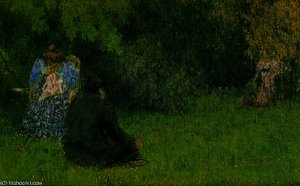
A Vision of Pastoral Beauty: Exploring the Artistry of Ker-Xavier Roussel
Ker-Xavier Roussel (1867 – 1944) stands as a singular figure within the Nabi movement, a collective of French painters who sought to liberate art from academic conventions and embrace Symbolist ideals. Born François Xavier Roussel in Lorry-lès-Metz, Moselle, his artistic journey began modestly but swiftly gained momentum thanks to formative connections with fellow artists like Édouard Vuillard and Diogène Maillart. These friendships fostered a shared intellectual curiosity and propelled him toward the influential studio of Maurice Denis, establishing the core of Les Nabis – a group dedicated to capturing fleeting impressions and conveying profound emotional resonance through much more than mere representation.
Roussel’s formal education at the École des Beaux-Ats in Paris provided him with foundational skills, but it was his immersion in Maillart's studio that truly ignited his artistic spirit. Here, he honed his technique and absorbed the stylistic nuances of Impressionism alongside Vuillard and Denis, shaping a distinctive visual language. As he matured, his work began to transcend the small-format pictures typical of the Nabis, evolving into large, brightly colored paintings in a Post-Impressionist style. His later years were marked by a prolific output of pastels, often depicting more somber themes of mythological death, reflecting a complex psychological depth that mirrored his own personal struggles with depression.
The Nabi Aesthetic and Mythological Symbolism
The Nabis championed a rejection of realism, prioritizing atmosphere and emotion over meticulous detail. Roussel’s canvases are characterized by muted palettes—often dominated by blues and greens—that evoke the tranquility of rural landscapes. However, these serene vistas rarely depict empty spaces; instead, they populate them with figures – women, nymphs, and fauns – imbued with mythological symbolism. He possessed a unique ability to adapt local scenery, such as the areas around L'Étang-la-Ville and Saint-Tropez, into epic Greek mythological episodes.
Roussel's artistic vision was profoundly impacted by Symbolist thinkers like Gustave Moreau and Edvard Munch, whose explorations of psychological depth and dreamlike imagery resonated deeply within him. He skillfully blended Impressionistic brushwork with Symbolist motifs, creating paintings that are both visually captivating and intellectually stimulating. His work often celebrated the sensory joys of life—the seasons, abundance, and dance—yet it also contained a voyeuristic, sometimes unsettling edge. This duality is evident in his ability to depict:
- Erotic Joy: Capturing the "glorious blaze of the flesh" through bucolic scenes of nymphs and centaurs.
- Mythological Drama: Illustrating literary works, such as Stéphane Mallarmé's L'après-midi d'un faune, with a sense of mystery.
- Melancholic Shadows: Utilizing dark lithographic illustrations to explore more somber, mythological themes.
Legacy and Historical Significance
The historical significance of Ker-Xavier Roussel lies in his ability to bridge the gap between the fleeting light of Impressionism and the deep, psychological symbolism of the late 19th century. While many of his contemporaries focused on the domestic or the urban, Roussel turned toward a pastoral, almost primordial world where the boundaries between reality and myth were blurred. His use of family members, including his wife Marie (the sister of Édouard Vuillard) and his children, as models allowed him to infuse his mythological landscapes with a sense of intimate, lived experience.
Through his mastery of color and his devotion to the symbolic power of nature, Roussel left an indelible mark on French modernism. His work remains a testament to a period when art sought to move beyond the visible world to touch the unseen, creating a legacy of beauty that is as intellectually profound as it is visually enchanting.