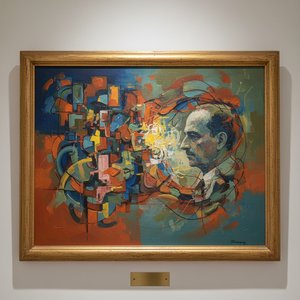
Stanhope Alexander Forbes: A Cornish Visionary of the Late Victorian Era
Born in Dublin in 1857, Stanhope Alexander Forbes’s artistic journey was a testament to perseverance and a deep connection to the natural world. His early life, marked by a move to England and an education nurtured by his art-enthusiastic father, laid the foundation for a career that would ultimately establish him as one of the leading landscape painters of the late Victorian era, particularly within the vibrant Cornish art colony. Forbes’s work is characterized by a remarkable blend of realism and romanticism, capturing not just the outward appearance of the coastal landscapes but also imbuing them with an emotional resonance—a sense of solitude, contemplation, and the sublime power of nature.
Forbes's artistic training began at Dulwich College, where his talent for drawing was recognized. He then enrolled in the Royal Academy Schools in London, benefiting from the tutelage of influential figures like Frederic Leighton and Lawrence Alma-Tadema. However, it was a pivotal move to France in 1878 that truly shaped his artistic development. Spending two years at Leon Bonnat’s atelier in Clichy, Paris, exposed him to the tenets of French plein-air painting—a technique emphasizing direct observation and capturing the fleeting effects of light and atmosphere. This experience profoundly influenced his approach to landscape painting, encouraging a heightened sensitivity to color, texture, and the dynamic interplay of light on the Cornish coast.
Upon returning to England, Forbes established himself in Newlyn, Cornwall – a region that had become a magnet for artists seeking inspiration from its dramatic coastline. This location proved crucial to his artistic evolution. He immersed himself in the local art community, forging friendships with fellow painters and engaging with the burgeoning Cornish art movement. His studio became a hub of creative exchange, fostering experimentation and pushing the boundaries of traditional landscape painting. Forbes’s work during this period is particularly notable for its evocative depictions of fishing boats, rugged cliffs, and the ever-changing moods of the sea – scenes that resonated deeply with his own contemplative nature.
The Cornish Influence: Light, Color, and Subject Matter
Cornwall provided Forbes with an unparalleled environment for artistic exploration. The region’s dramatic coastline—characterized by towering granite cliffs, secluded coves, and expansive beaches—offered a constant source of visual stimulation. More importantly, the light in Cornwall was exceptionally unique, shifting dramatically throughout the day and year. Forbes meticulously studied these variations, striving to capture their subtle nuances on canvas. His use of color became increasingly vibrant and expressive, reflecting the intensity of the Cornish light.
Furthermore, Forbes’s subject matter—the everyday lives of fishermen, farmers, and rural communities—provided a powerful counterpoint to the idealized landscapes often depicted by his contemporaries. He wasn't interested in grand vistas or heroic narratives; instead, he focused on capturing the quiet dignity and resilience of ordinary people within their natural surroundings. This commitment to realism, combined with his artistic sensibility, resulted in paintings that were both visually stunning and emotionally resonant.
Technique and Style: A Balance of Realism and Romanticism
Forbes’s technique was characterized by a remarkable blend of realism and romanticism. He meticulously observed the details of his subjects—the texture of weathered stone, the ripples on the water's surface, the folds in fishermen’s clothing—rendering them with astonishing accuracy. However, he also employed expressive brushwork and a rich palette to convey mood and atmosphere. His paintings are not simply representations of reality; they are imbued with a sense of feeling—a palpable connection between the artist and his subject.
His compositions often feature strong diagonals and asymmetrical arrangements, creating a dynamic visual tension that draws the viewer’s eye across the canvas. Forbes skillfully used light and shadow to sculpt forms and create depth, while his color choices were both realistic and emotionally charged. He was particularly adept at capturing the effects of atmospheric perspective—the subtle blurring of distant objects—which added a sense of vastness and mystery to his landscapes.
Legacy and Recognition
Despite facing considerable challenges throughout his career, Stanhope Alexander Forbes achieved widespread recognition for his contributions to British landscape painting. He exhibited regularly at the Royal Academy in London from 1878 until his death in 1947, solidifying his place as a leading figure in the art world. His work was also featured in exhibitions across Britain and abroad, including the New Gallery in London and the St. Ives Arts Club.
Forbes’s legacy extends beyond his individual paintings. He played a significant role in fostering the Cornish art colony, encouraging other artists to embrace the region's unique landscape and culture. His dedication to realism, combined with his artistic sensitivity and profound connection to nature, continues to inspire artists today. Stanhope Alexander Forbes remains a vital figure in British art history—a testament to the power of observation, imagination, and the enduring beauty of the Cornish coast.