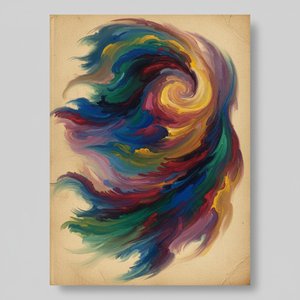
Jackson Pollock: A Revolutionary of American Abstraction
Born in Cody, Wyoming, in 1912, Paul Jackson Pollock—as he was initially known—emerged from a transient childhood marked by frequent moves across the American West and Southwest. His family’s itinerant existence, rooted in Scotch-Irish heritage and shaped by his father's service in the Boer War, instilled within him a restless spirit and an acute awareness of movement and change. This early life, characterized by instability and a deep connection to the landscape, would profoundly influence his artistic vision, shaping a career dedicated to capturing the dynamism of experience rather than fixed representation.
Pollock’s formal art training was limited; he briefly attended Manual Arts High School in Los Angeles but ultimately eschewed traditional academic instruction. Instead, he immersed himself in the burgeoning avant-garde scene of New York City during the 1940s, encountering and absorbing the ideas of artists like Piet Mondrian, Franz Klee, and Joan Miró. These encounters proved pivotal, exposing him to non-representational forms and encouraging a shift away from traditional artistic conventions. It was in this environment that he began to develop his signature technique – what would later be termed “drip painting” or “action painting.”
The Birth of Action Painting
Pollock’s revolutionary approach to painting emerged almost accidentally, beginning around 1947. Frustrated with the constraints of conventional easel painting and seeking a way to express his inner state directly onto the canvas, he began experimenting with pouring and dripping paint from buckets and sticks onto large canvases laid flat on the floor. This process, initially driven by a desire for spontaneity and immediacy, quickly evolved into a highly controlled and deliberate act. He would often work for extended periods, moving around the canvas, manipulating the paint with his entire body – a technique that became known as “action painting.”
Unlike earlier abstract artists who sought to create purely intellectual or geometric compositions, Pollock’s paintings were imbued with an intense physicality and emotional energy. The seemingly random splatters and drips, when viewed closely, reveal a complex system of control and intention. He meticulously planned the placement of each element, creating layered textures and dynamic rhythms that conveyed a sense of movement and vitality. His work was not about depicting a specific subject but rather about expressing the process of painting itself – the artist’s engagement with materials and the act of creation.
Key Works and Influences
Pollock's most celebrated works, such as “Number 1, 1950” (MoMA), “Lavender Mist” (Katz de la Varenne), and “Convergence” (1952), exemplify his unique style. These paintings are characterized by their expansive scale, dense layering of color, and the absence of recognizable imagery. The influence of Surrealism is evident in the dreamlike quality of some of his works, while the dynamism of his technique owes a debt to Cubist fragmentation and the gestural energy of Abstract Expressionists like Willem de Kooning.
However, Pollock’s artistic lineage extends beyond these immediate influences. He was also deeply inspired by Native American art, particularly the sand paintings created by Pueblo tribes. The ephemeral nature of these ritualistic artworks—created and destroyed in a single day—resonated with Pollock's own desire to capture fleeting moments of experience. His work with Lee Krasner, his wife and fellow artist, further fueled his creative exploration, providing him with a vital intellectual and emotional partnership.
Legacy and Historical Significance
Despite facing initial skepticism from the art establishment, Jackson Pollock’s radical approach to painting ultimately revolutionized American art. He is widely considered one of the pioneers of Abstract Expressionism, a movement that profoundly impacted the course of 20th-century art. His willingness to challenge traditional notions of representation and embrace spontaneity and process paved the way for subsequent generations of artists to explore new forms of expression.
Pollock’s legacy extends beyond his artistic achievements. He became a cultural icon, embodying the spirit of postwar America—its dynamism, its anxieties, and its relentless pursuit of innovation. His life, marked by struggles with alcoholism and personal tragedy, serves as a poignant reminder of the sacrifices often made in the name of artistic vision. He died tragically in 1956 at the age of 44, leaving behind a body of work that continues to captivate and inspire audiences worldwide.