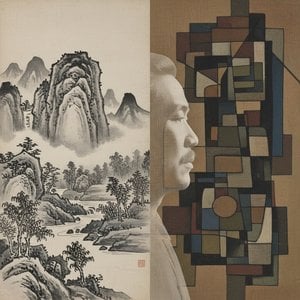
Kaii Higashiyama: A Master of Japanese Landscape and Contemplative Art
Kaii Higashiyama (1908-1999) stands as one of the most beloved and enduring figures in post-war Japanese art. Born Shinkichi in Yokohama, his journey to becoming Kaii Higashiyama – a name he adopted at age three – was marked by a profound engagement with both Western artistic traditions and the deeply rooted aesthetics of Japan. His work transcends mere landscape painting; it’s an exploration of solitude, nature's quiet power, and a subtle yearning for connection, rendered in a distinctive Nihonga style that continues to captivate viewers today.
Higashiyama’s early life shaped his artistic sensibilities. Moving to Kobe at the age of three, he received a traditional Japanese education before pursuing formal training at Tokyo School of Fine Arts. This foundation provided him with a strong grounding in classical Japanese painting techniques, but it was his subsequent sojourn in Europe – specifically Berlin – that proved transformative. Immersed in Western art history and encountering diverse artistic movements, Higashiyama began to synthesize these influences with his existing knowledge, developing a unique visual language.
The Development of Nihonga Style
Higashiyama’s artistic evolution is inextricably linked to the revival of *Nihonga*, a traditional Japanese painting style that emphasizes brushwork, texture, and atmospheric effects over precise representation. Unlike Western art's focus on realism, *Nihonga* prioritizes conveying emotion and spiritual resonance through subtle gradations of color and line. Higashiyama masterfully employed this approach, creating landscapes imbued with a sense of quiet contemplation and profound connection to the natural world.
His early works often featured stark, minimalist compositions—often depicting mountains or water—that conveyed a feeling of isolation and introspection. This evolved over time as he incorporated elements of Chinese landscape painting, particularly the *shan shui* tradition, which emphasizes capturing the essence of nature through suggestive brushstrokes and atmospheric perspective. He was deeply influenced by the concept of “borrowed scenery,” a technique where distant mountains or landscapes are subtly included in a painting to create a sense of depth and connection to the wider world.
Major Works and Recognition
Higashiyama’s career gained significant momentum in 1947 with the exhibition of *Afterglow*, a work that established his distinctive style and garnered critical acclaim. This success led to numerous commissions, including murals for important buildings such as Toshodai-ji Temple in Nara, where he created a series of monumental screen paintings depicting landscapes from Japan and China. These works, characterized by their delicate brushwork, subtle color palettes, and evocative atmosphere, are considered masterpieces of Japanese landscape painting.
Throughout his career, Higashiyama received numerous accolades recognizing his artistic merit. In 1956, he was awarded the Japan Art Academy Prize, and in 1969, he was honored with the Order of Culture – a prestigious distinction bestowed upon individuals who have made significant contributions to Japanese culture. His work has been exhibited extensively both in Japan and internationally, cementing his place as one of the most important artists of the 20th century.
Legacy and Influence
Kaii Higashiyama’s legacy extends far beyond his individual works. He played a crucial role in preserving and revitalizing *Nihonga* style, inspiring generations of Japanese painters to embrace this traditional approach while simultaneously incorporating contemporary sensibilities. His emphasis on quiet contemplation, the beauty of nature, and the power of suggestion continues to resonate with viewers today.
Higashiyama’s paintings are not merely representations of landscapes; they are invitations to a deeper engagement with the natural world—a reminder of our place within it and the importance of finding solace in its enduring presence. His work stands as a testament to the power of art to evoke emotion, stimulate reflection, and connect us to something larger than ourselves.