The Luminous Legacy of Julio Vila y Prades
In the golden era of Spanish Impressionism, few artists captured the ephemeral dance of light and the quiet dignity of tradition as tenderly as Julio Vila y Prades. Born in Valencia in 1873, his life was a journey through the vibrant landscapes of Spain and the sweeping vistas of Latin America, leaving behind a body of work that serves as a window into a bygone era. His artistic soul was forged in the prestigious halls of the Real Academia de Bellas Artes de San Carlos, where, despite his parents' initial reservations, he pursued a calling that would eventually define his existence. This early dedication to the craft allowed him to master the nuances of form and color, setting the stage for a career marked by both technical precision and emotional depth.
The trajectory of Vila y Prades’s style was irrevocably altered by his profound encounter with the legendary Joaquín Sorolla. Serving as an assistant in Sorolla's workshop from 1893 to 1904, the young painter absorbed the master's unparalleled ability to translate the Mediterranean sun onto canvas. This mentorship instilled in him a lifelong fascination with the fleeting nature of light—the way it dances across a white mantilla or illuminates a rural landscape at dusk. Through this influence, Vila y Prates developed a signature technique that blended the soft, expressive brushstrokes of Impressionism with the evocative, often mysterious undertones of Symbolism, creating works that felt both immediate and timeless.
A Tapestry of Spanish Life and Light
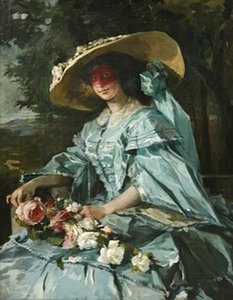
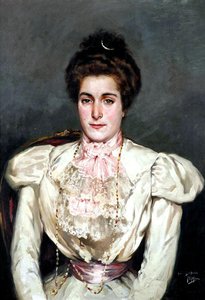
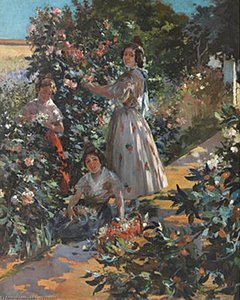
The oeuvre of Julio Vila y Prades is a rich tapestry woven from the threads of everyday Spanish life. He possessed a rare gift for elevating genre scenes—simple moments of domesticity or regional character—into profound meditations on culture and identity. His landscapes, particularly those depicting the sun-drenched regions of Catalonia, are far more than mere topographical records; they are atmospheric experiences that invite the viewer to feel the warmth of the Spanish sun and the stillness of the countryside. In his hands, a field becomes a stage for light, and a simple portrait becomes an exploration of human dignity.
His notable works often focus on the intersection of person and place, characterized by:
- Española con Mantilla: A 1913 masterpiece that exemplifies his ability to capture joy and movement, featuring a woman in a white mantilla amidst a lively, sunlit scene.
- Tipos regionales: A series of portraits that utilize muted tones and realistic textures to celebrate the enduring spirit and traditional attire of Spanish regional figures.
- La Niña de la Lampara: A captivating study of light and shadow, where a single lantern illuminates a subject, showcasing his post-impressionist mastery of chiaroscuro.
Beyond his easel paintings, Vila y Prades was also a skilled muralist, contributing to the decorative and architectural grandeur of his time. His ability to scale his vision from the intimate detail of an oil portrait to the sweeping narrative of a mural allowed him to leave a lasting mark on both private collections and public spaces. As he moved through Spain and Latin America, his work acted as a cultural bridge, carrying the essence of Spanish tradition into new territories. Today, his legacy remains a vital part of the art historical canon, reminding us of a period when the brush could capture not just what the eye sees, but what the heart feels.