A Life Captured in Light and Landscape
The life of Joseph Murray Ince was a delicate tapestry woven between the bustling streets of London and the serene, rolling hills of Wales. Born in April 1806 in Marylebone, London, his early years were shaped by the pastoral beauty of Presteigne in Radnorshire, where he spent much of his childhood. This dual connection to both the cosmopolitan energy of the English capital and the rugged, natural splendor of the Welsh landscape would become the cornerstone of his artistic vision. As a young man, Ince displayed an unwavering certainty in his calling, dedicating himself immediately to the pursuit of painting. His formal training began under the guidance of the esteemed painter David Cox, studying with him from 1823 to 1826. This apprenticeship provided him with a foundational mastery of light and atmosphere that would define his later works.
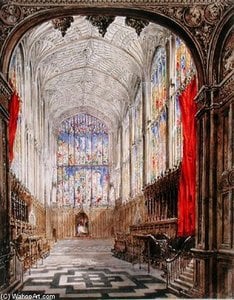
In 1826, Ince moved to London, a pivotal moment that allowed his talent to reach the wider art world. He began exhibiting at the prestigious Royal Academy, and his work eventually found its way into the galleries of the British Institution. His artistic range was remarkably broad; while he is celebrated for his landscapes, he also possessed a keen eye for architectural precision. During the 1s30s, he served as a drawing master at Cambridge University, where he produced intricate architectural drawings and views of the historic colleges in both Oxford and Cambridge. This period of his life showcased a meticulous ability to capture the structural grandeur of academic institutions, blending topographical accuracy with an artist's sensitive touch.
The Essence of the British Landscape
Ince’s oeuvre is a profound meditation on the natural world, particularly the local scenes of Wales and the maritime beauty of coastal regions. His paintings often evoke a sense of peace and harmony, capturing the idyllic rhythms of rural life. Through his use of watercolour and oil, he brought to life scenes of harvesting, woodcutting, and the quiet presence of contemporary people and their animals. There is an evocative quality to his depictions of the Brecon Beacons and Hay-on-Wye, where the landscape feels both intimately familiar and timelessly majestic. His ability to render the textures of nature—the softness of a misty morning or the ruggedness of a stone ruin like Raglan Castle—demonstrates a deep emotional connection to his subject matter.
Beyond the purely pastoral, Ince’s work also touched upon the maritime and the urban. His versatility allowed him to transition seamlessly from the tranquil lakes near Dolgelly to detailed engravings of English towns. This breadth of subject matter ensured that his art remained a vital record of the 19th-century landscape. Even as he returned to Presteigne around 1835, maintaining a professional connection to his London clientele, his heart remained tethered to the landscapes that had nurtured his early development. His legacy survives through the collections of esteemed institutions such as the Tate, the British Museum, and the Art Institute of Chicago, where his drawings and watercolours continue to offer a window into a vanished era of British naturalism.
Questions & Answers
Can I browse Joseph Murray Ince's works by movement?
The movements Joseph Murray Ince worked in can be seen on the artist's All Movements page, which groups the artworks by movement.
Is there an overview of all the subjects Joseph Murray Ince painted?
The Subject Atlas of Joseph Murray Ince is a page that maps the artist's artworks by their subjects.
How can I see every artwork made by Joseph Murray Ince?
Every work by Joseph Murray Ince on this website can be browsed from the artist's All Artworks page.
What are the birth city and country of Joseph Murray Ince?
Joseph Murray Ince was born in London, in United Kingdom.
Where is Joseph Murray Ince from?
Joseph Murray Ince was born in United Kingdom.
Can I visit a virtual museum of Joseph Murray Ince's works?
A virtual visit is possible: the 3D Museum page of Joseph Murray Ince presents the artist's works in a three-dimensional gallery.
What are the birthplace and birth year of Joseph Murray Ince?
Joseph Murray Ince was born in London in 1806.