Joseph John Collier: A Master of Victorian Landscape
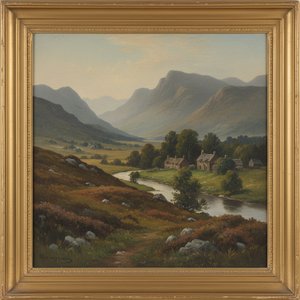
Born in London in 1815, Joseph John Collier emerged as a significant figure within the British art scene during the mid-19th century. His life and career were inextricably linked to his family’s prominent standing – his grandfather was a Quaker merchant and member of Parliament, and his father followed in that tradition. This lineage undoubtedly provided him with opportunities and connections, yet Collier forged his own distinct path as a landscape painter, renowned for his meticulous detail and evocative depictions of the natural world, particularly the dramatic vistas of Scotland and the Lake District.
Collier’s early life was marked by both artistic training and practical experience. He began his formal education at the Royal Academy in London, honing his skills in traditional techniques. However, he quickly distinguished himself as a drawing master, instructing students at several schools throughout the city – a role that undoubtedly sharpened his observational abilities and understanding of form. This dual existence—artist and educator—shaped his approach to painting, fostering a deep appreciation for technique alongside a commitment to sharing his knowledge.
A Pre-Raphaelite Influence
Collier’s artistic style is often categorized within the broader context of the Pre-Raphaelite movement, though he never formally identified with its manifestos. The influence of this influential group—known for their reverence for medieval art and a rejection of academic conventions—is evident in Collier's meticulous rendering of detail, his use of rich color palettes, and his tendency to explore themes of mythology and legend. Like his Pre-Raphaelite contemporaries, Collier sought to capture the beauty and drama of nature with an almost photographic realism, prioritizing observation and emotional response over purely representational accuracy.
However, Collier’s work possesses a unique character that sets it apart from the more overtly romanticized depictions often associated with the Pre-Raphaelites. His landscapes are imbued with a quiet dignity and a sense of timelessness, reflecting a deep connection to the land itself. He was particularly drawn to the rugged beauty of the Scottish Highlands and the serene majesty of the Lake District, capturing their atmospheric qualities with remarkable skill.
Notable Works and Artistic Techniques
Collier’s most celebrated works include “Rainbow Falls, Manitou,” a stunning albumen print showcasing the power and beauty of a cascading waterfall – now housed in the J. Paul Getty Museum in Los Angeles. This image exemplifies his mastery of tonal range and his ability to convey both the grandeur and the delicate intricacies of natural phenomena. Other significant paintings depict dramatic mountainscapes, dense forests, and serene lakes, each rendered with painstaking detail and a keen eye for light and shadow.
His technique involved extensive sketching in situ – directly observing and documenting the landscapes he intended to paint. This commitment to direct observation is reflected in the remarkable realism of his work, particularly in the depiction of foliage, water surfaces, and geological formations. Collier’s use of color was equally deliberate, employing a rich palette of hues to create atmospheric effects and evoke specific moods.
Legacy and Recognition
During his lifetime, Joseph John Collier enjoyed considerable recognition within the British art world. He exhibited his work at prestigious institutions such as the Royal Academy, the British Institution, and the Society of British Artists, solidifying his reputation as a leading landscape painter. His paintings are now held in prominent collections worldwide, including the Tate Gallery in London and the Metropolitan Museum of Art in New York – testament to the enduring appeal of his art.
Collier’s legacy extends beyond his individual works; he represents a pivotal moment in British landscape painting, bridging the gap between traditional academic training and the emerging aesthetic sensibilities of the Victorian era. His meticulous technique, coupled with his deep appreciation for the beauty of the natural world, continues to inspire artists and captivate viewers today. Further exploration can be found on WahooArt.com and through resources like Wikipedia and the Victorian Web.
Questions & Answers
How is Joseph John Collier's career divided into periods?
The Chronicle of Joseph John Collier is a scroll-driven timeline that presents the artist's works in chronological order, grouped into career-period chapters.
What are the birthplace and birth year of Joseph John Collier?
Joseph John Collier was born in London in 1815.
Can I browse Joseph John Collier's works by medium?
The All Medium page groups Joseph John Collier's artworks by technique.