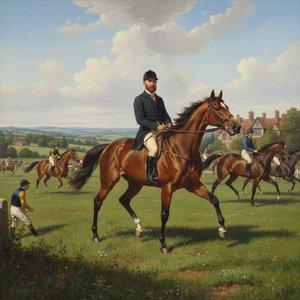
A Legacy of Light and Line: The Life of John Prescott Knight
In the grand tapestry of Victorian art, few figures occupied a position as influential and multifaceted as John Prescott Knight. Born in 1803 into an environment of intellectual prestige—the son of the esteemed barrister Edward Knight—Knight’s early life was steeped in the refined sensibilities of the British upper class. This upbringing provided more than just social standing; it offered a profound connection to the cultural currents of his time. His formative years at Eton College, under the watchful eye of the poet and illustrator William Hayley Jr., planted the seeds of a lifelong devotion to the visual arts. It was here that Knight first mastered the delicate nuances of watercolor, a medium that would later inform the atmospheric sensitivity found in his more mature oil compositions.
As his talent matured, Knight moved beyond the pastoral charm of landscape painting toward the rigorous demands of academic portraiture. His journey led him to Somerset House, where he immersed himself in the formal study of oil techniques, refining a style that would eventually bridge the gap between Romanticism and the psychological realism of the mid-Victorian era. This evolution was not merely technical but deeply philosophical, as he sought to move beyond simple likeness to capture the very essence of his subjects' characters.
The Architect of the Royal Academy
Knight’s career was defined by a rare combination of creative brilliance and institutional leadership. His election as a Fellow of the Royal Academy in 1829 marked his ascent into the highest echelons of the British art world. However, it was his extraordinary tenure as the Secretary to the Academy—a position he held for over five decades—that allowed him to shape the very trajectory of English art history. In this capacity, Knight acted as a gatekeeper and a guide, navigating the complex politics of the London art scene and facilitating the growth of the institution during a period of immense cultural transformation.
This administrative mastery did not come at the expense of his personal artistry. On the contrary, his deep involvement in the Academy provided him with an unparalleled vantage point from which to observe the shifting tides of taste. He witnessed the transition from the sweeping, dramatic landscapes influenced by Turner to a new era of focused, character-driven portraiture. His ability to maintain his creative relevance while managing the administrative heart of British art remains one of the most remarkable feats of his professional life.
Mastery of Portraiture and Dramatic Narrative
The true hallmark of Knight’s oeuvre lies in his profound command of chiaroscuro and emotional resonance. While many of his contemporaries focused on the external trappings of wealth and status, Knight sought the internal landscape of the human soul. His portraits are celebrated for their uncanny ability to capture fleeting expressions and subtle psychological depths, utilizing dramatic contrasts of light and shadow to create a sense of living presence. Through these techniques, he imbued his canvases with an atmosphere that feels both intimate and timeless.
Beyond the individual portrait, Knight demonstrated a remarkable aptitude for large-scale, complex compositions that blended historical narrative with theatrical flair. His works often functioned as much like stage productions as they did paintings, capturing grand moments of historical significance with a sense of movement and drama. His contributions to the art of the era can be summarized through several key artistic pillars:
- Psychological Depth: The use of subtle facial nuances to reveal the inner lives and temperaments of his sitters.
- Atmospheric Technique: A masterful application of light and shadow to heighten the emotional impact of a scene.
- Narrative Ambition: The ability to compose large-scale group scenes that convey historical weight and theatrical energy.
- Institutional Influence: A lifelong dedication to the Royal Academy, ensuring the continuity of academic excellence in Britain.
Ultimately, John Prescott Knight remains a cornerstone of 19th-century British art. He was an artist who understood that a portrait is not merely a record of a face, but a window into an era. Through his dual legacy as a painter of profound sensitivity and a pillar of the artistic establishment, he helped define the visual language of the Victorian age.
Questions & Answers
What aliases or alternate names does John Prescott Knight have?
John Prescott Knight appears under the alternate names Edward Knight Son.
Where can I see John Prescott Knight's artworks in a 3D gallery?
John Prescott Knight's artworks can be seen in a 3D gallery on the artist's 3D Museum page.
Can I explore John Prescott Knight's works by color spectrum?
John Prescott Knight's works can be explored by color on the artist's Spectral Index page.
Where are John Prescott Knight's artworks grouped by art movement?
The movements John Prescott Knight worked in can be seen on the artist's All Movements page, which groups the artworks by movement.
In which historical period did John Prescott Knight work?
John Prescott Knight worked in the 19th-Century period. The period situates the artist's activity in history.
Where can I see John Prescott Knight's artworks in chronological order?
A timeline of John Prescott Knight's works exists: the artist's Artwork Timeline page orders the artworks by creation date.
How do I find works by John Prescott Knight in a specific palette?
To find works by John Prescott Knight in a specific palette, use the artist's By Palettes page.
How many artworks by John Prescott Knight are available to browse?
You can browse 52 artworks by John Prescott Knight on the All Artworks page.