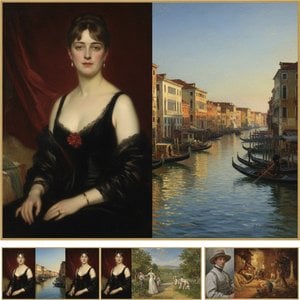
John Macdonald Aiken: A Portraitist of Scottish Life
Born in Aberdeen in 1880, John Macdonald Aiken emerged as a significant figure in late nineteenth and early twentieth-century British art, primarily recognized for his meticulously rendered portraits and evocative depictions of the Scottish landscape. His career spanned over six decades, marked by a dedication to capturing both the outward appearance and inner character of his subjects – from prominent figures of the era to humble rural communities. Aiken’s artistic journey was shaped by a rigorous apprenticeship, formal training in prestigious art institutions, and a deep connection to his native land, resulting in a body of work that reflects a unique blend of technical skill, psychological insight, and regional pride.
Aiken's early artistic development began with a six-year apprenticeship under the lithographer Robert Gibb RSA. This formative experience instilled within him a strong foundation in draughtsmanship and an understanding of visual communication – skills he would later apply to his painting. He subsequently studied at Gray’s School of Art in Aberdeen, honing his technical abilities and exploring various artistic styles. Crucially, he also benefited from instruction at the Royal College of Art in London under Gerald Moira, a renowned figure known for his emphasis on decorative techniques and meticulous detail. Further study in Florence exposed him to Italian Renaissance influences, enriching his understanding of composition, color theory, and classical beauty.
Aiken’s artistic style evolved considerably throughout his career. Initially influenced by Moira's approach – characterized by a refined, almost polished aesthetic – he gradually developed a more individualistic voice. He became particularly adept at capturing the nuances of human expression, imbuing his portraits with a sense of immediacy and psychological depth. His landscapes, too, were not merely scenic representations but rather imbued with atmosphere and emotion, reflecting the rugged beauty and timeless spirit of the Scottish Highlands. His work frequently showcased a keen eye for detail, from the texture of clothing to the subtle play of light on stone, demonstrating his mastery of both oil paint and watercolour.
Notable Portraits and Artistic Recognition
Aiken’s portraiture became his most celebrated achievement. He produced numerous compelling likenesses of prominent figures – politicians, industrialists, academics, and members of the Scottish aristocracy. These portraits are not simply formal representations; they reveal a remarkable ability to capture the personality and character of each subject. His depiction of Harry Townend, exhibited at the Paris Salon in 1923 and later shown again in 1929, garnered particular acclaim, solidifying his reputation as one of Scotland’s leading portraitists. Other notable subjects included members of the Scottish elite, capturing their dignity and bearing with remarkable precision.
Beyond portraits, Aiken also produced a significant body of landscape paintings, often depicting scenes from the Highlands. These works are characterized by a deep appreciation for the natural world and a sensitivity to its changing moods. His depictions of Bennachie, a prominent landmark in Aberdeenshire, became particularly iconic, embodying the rugged beauty and timeless spirit of the region. His artistic recognition was substantial; he was elected Associate of the Royal Scottish Academy in 1923 and full member in 1935, demonstrating the esteem in which his work was held by his peers.
Influence and Legacy
Aiken’s influence on subsequent generations of Scottish artists is considerable. His meticulous technique, psychological insight, and regional pride served as a model for many who followed. He helped to establish a distinctively Scottish style within the broader context of British art, blending traditional techniques with a contemporary sensibility. His work continues to be exhibited in galleries across Scotland, testament to its enduring appeal and artistic merit.
Aiken’s legacy extends beyond his individual paintings. He played a vital role in fostering artistic education and development within Aberdeen, serving as Head of Gray's School of Art from 1911 to 1914. His commitment to nurturing young talent ensured the continuation of artistic traditions and contributed significantly to the cultural landscape of Scotland. His life and work offer a compelling glimpse into the vibrant artistic scene of early twentieth-century Britain, and his portraits remain treasured examples of Scottish art history.
Key Works
- Portrait of Harry Townend (1923): A pivotal portrait that established Aiken’s reputation as a leading portraitist.
- Scenes from Bennachie: A series of landscape paintings capturing the dramatic beauty of the Aberdeenshire hills.
- Various portraits of Scottish nobility and dignitaries: Demonstrating his ability to capture the dignity and character of prominent figures.
Later Life and Death
Following a period living in London, Aiken returned to Aberdeen, settling in Aboyne, where he continued to paint until his death in 1961. His work is now held in numerous public collections across Scotland, including the Aberdeen, Dundee, and Perth Art Galleries, ensuring that his artistic legacy endures for future generations.