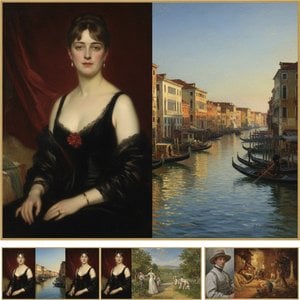
John Baptist de Medina: Life and Legacy
Early Life and Training
- Birth and Origins: Sir John Baptist de Medina was born in 1659 in Brussels, to a Spanish army captain. His early life was shaped by his family’s military background and the vibrant artistic environment of Brussels.
- Artistic Education: He received his initial artistic training under François Duchatel, a respected painter of the time. This foundational education instilled in him the principles of Baroque art and portraiture.
Move to England and Scotland
- London Years (1686): In 1686, de Medina moved to London, establishing his studio in Drury Lane. He quickly gained recognition for his portraiture skills.
- Scottish Patronage: De Medina specialized in painting Scottish sitters even while in London. Later, around 1688-89 or 1694, he relocated to Edinburgh, where he remained for the rest of his life. He was greatly encouraged and sponsored by the Earl of Melville.
- Political Connections: The Earl of Melville’s influence was crucial; as Secretary of State for Scotland, he provided de Medina with access to prominent figures and commissions.
Artistic Style and Influences
- Baroque Portraiture: De Medina’s style is firmly rooted in the Baroque tradition. His portraits are characterized by a sense of realism, dramatic lighting, and rich colors.
- Influences: He was significantly influenced by Sir Godfrey Kneller, whose portrait style he emulated, but often with a more relaxed and informal approach.
- Distinctive Features: De Medina favored bright blues and rose-reds in clothing and dark backgrounds. The quality of his work varied, likely due to the assistance of studio assistants.
Major Achievements and Works
- Portrait Series at Surgeons’ Hall: His most celebrated works are a collection of approximately 30 oval bust-length portraits housed in Surgeons' Hall, Edinburgh. These are often compared to Kneller’s Kit Cat Club series.
- *Paradise Lost* Illustrations (1688): De Medina was the first artist to illustrate John Milton’s epic poem *Paradise Lost*. His twelve engraved plates for the 1688 edition are notable for their careful adherence to the text and imaginative use of biblical iconography.
- Portraits of Scottish Nobility: He created numerous portraits of prominent Scottish figures, solidifying his position as the leading portraitist in Scotland during his lifetime.
Historical Significance and Legacy
- Dominant Portraitist: De Medina held a near-monopoly on portraiture in Scotland for much of his career, charging standard fees of £5 for a head and £10 for a half-length portrait.
- Knighthood (1706): He was knighted in 1706, one of the last Scottish knights created before the Acts of Union in 1707.
- Mentorship: De Medina trained both his son and William Aikman, who became a leading Scottish portrait painter of the next generation.
- Lasting Impact: While not as widely recognized internationally as some of his contemporaries, de Medina’s work provides valuable insight into 17th-century Scottish society and artistic practice.
Death and Burial
- Final Years: John Baptist de Medina died in Edinburgh on October 5, 1710.
- Burial Site: He was buried in Greyfriars Kirkyard, Edinburgh, in a solid enclosed vault near the steps leading to the northern section.
Questions & Answers
In which historical period did John Baptist De Medina work?
John Baptist De Medina worked in the Early-Modern period. The period situates the artist's activity in history.
Is there a chronological account of John Baptist De Medina?
John Baptist De Medina's career unfolds period by period on the artist's Chronicle page: a horizontal timeline of the artworks, grouped into career-period chapters.
How many artworks by John Baptist De Medina are available to browse?
You can browse 57 artworks by John Baptist De Medina on the All Artworks page.
Is there a complete list of John Baptist De Medina's artworks?
Every work by John Baptist De Medina on this website can be browsed from the artist's All Artworks page.
Can I explore John Baptist De Medina's works by subject?
The Subject Atlas page maps John Baptist De Medina's artworks by subject.
What moods do John Baptist De Medina's artworks express?
John Baptist De Medina's works can be browsed by mood on the artist's Mood Room page, which arranges the artworks by their recorded moods.
What colors did John Baptist De Medina use most often?
The color profile of John Baptist De Medina's work is shown on the artist's Palette Genome page.