Johannes Bosboom: Capturing the Soul of Dutch Interiors
Johannes Bosboom, a name perhaps less familiar than some of his contemporaries within the Hague School, nevertheless stands as a quietly profound figure in Dutch art history. Born in The Hague in 1817, Bosboom dedicated his life to meticulously observing and rendering the serene beauty of church interiors and evocative landscapes, earning him a unique place within the artistic landscape of 19th-century Netherlands. His work isn’t characterized by dramatic narratives or bold brushstrokes; rather, it's a subtle exploration of light, shadow, and atmosphere—a masterful manipulation of tonal values that invites viewers into a contemplative space.
Bosboom’s artistic journey began under the tutelage of Bartholomeus van Hove at the tender age of fourteen. This early apprenticeship proved formative, immersing him in the world of theatrical scenery painting – a demanding environment where he honed his skills in composition and color theory alongside Van Hove's son, Hubertus. Further formal training followed at the Hague Academy of Art from 1831 to 1835 and again between 1839 and 1840, providing him with a solid foundation in technique while also fostering connections with fellow artists like Anthonie Waldorp and Wijnand Nuyen. A pivotal moment arrived in 1835 when he traveled to Düsseldorf, Cologne, and Koblenz, capturing the evocative watercolor view of the Mosel Bridge at Koblenz – a piece that would later be acquired by Andreas Schelfhout, who became a lifelong confidante and friend, offering invaluable support and encouragement throughout Bosboom’s career.
Bosboom's artistic focus quickly settled on church interiors. This choice wasn’t merely stylistic; it represented a deliberate exploration of spatial atmosphere. Drawing inspiration from the seventeenth-century masters Pieter Saenredam and Emanuel de Witte, he sought to recreate the feeling of reverence and stillness found within these sacred spaces. He meticulously studied the interplay of light filtering through stained glass windows, the subtle gradations of color in the stone walls, and the way shadows danced across the floor – translating these observations onto canvas with remarkable accuracy and sensitivity. His paintings aren’t literal depictions but rather carefully constructed evocations, designed to transport the viewer into a realm of quiet contemplation.
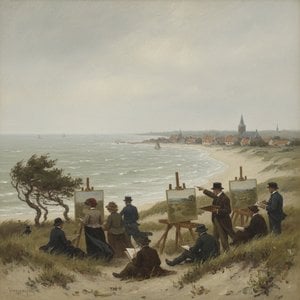
While often categorized within the Hague School, Bosboom's approach distinguished him from some of his peers. He wasn’t interested in capturing fleeting moments or dramatic scenes; instead, he focused on creating an enduring sense of atmosphere and mood. His meticulous attention to detail and his masterful use of light and shadow place him firmly within the mainstream of this artistic movement, yet his unique sensibility ensured that his work retained a distinct character. In 1873, during a sojourn in Scheveningen, he shifted his focus to watercolors of coastal scenes – dunes, beaches, and the sea – suggesting a possible influence on later artists like Hendrik Willem Mesdag and Jacob Maris who similarly explored the beauty of the Dutch coastline.
Honors and Recognition
Bosboom’s dedication to his craft was recognized with several honors throughout his career. In 1886, he was appointed an Officer in the Order of Leopold, a prestigious distinction acknowledging his contributions to the arts and culture of the Netherlands. This recognition further solidified his position as a respected figure within the artistic community.
Notable Works
Bosboom’s oeuvre is characterized by a remarkable consistency in subject matter – primarily church interiors – yet each painting possesses its own unique character and charm. Some of his most celebrated works include:
- Bakenesserkerk interior (1870): A serene depiction of the Bakenesser Church, showcasing Bosboom’s mastery of light and shadow.
- Interior of the Dom in Trier (1880): A meticulously rendered view of the Trier Cathedral, capturing its grandeur and spiritual atmosphere.
- Interieur van een boerendeel bij hilversum (Interior of a Farmhouse near Hilversum): A quieter scene, demonstrating his ability to capture the essence of rural life.
- Zicht te koblenz (View at Koblenz): A watercolor capturing the Mosel Bridge and surrounding landscape.
Legacy and Influence
Johannes Bosboom’s legacy extends beyond the individual paintings that grace museum collections. His meticulous observation, his profound understanding of light and shadow, and his unwavering commitment to capturing the essence of space have had a lasting influence on Dutch art. He demonstrated that beauty could be found in the quietest corners, in the subtle details of everyday life—a lesson that continues to resonate with artists today. While perhaps not as widely celebrated as some of his contemporaries, Bosboom’s work remains a testament to the power of observation and the enduring appeal of serene, contemplative art.
Questions & Answers
What colors did Johannes Bosboom use most often?
Johannes Bosboom's use of color across the works listed on this website can be studied on the artist's Palette Genome page.
Where can I see Johannes Bosboom's artworks in chronological order?
Johannes Bosboom's artworks can be seen in chronological order on the artist's Artwork Timeline page.
How did Johannes Bosboom's art evolve over time?
A chronological account of Johannes Bosboom's work is available on the artist's Chronicle page, where the artworks pass in order of creation, chapter by chapter.
Where are Johannes Bosboom's artworks mapped by subject?
The Subject Atlas page maps Johannes Bosboom's artworks by subject.
What are the birth city and country of Johannes Bosboom?
Johannes Bosboom was born in The Hague, in Netherlands.
What are the birthplace and birth year of Johannes Bosboom?
Johannes Bosboom was born in The Hague in 1817.
Where is Johannes Bosboom from?
Johannes Bosboom was born in Netherlands.