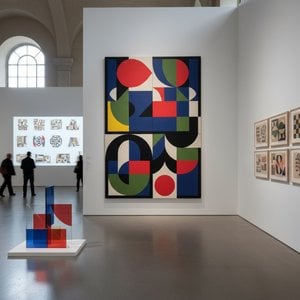
Jean Dewasne: A Pioneer of Geometric Abstraction
Jean Dewasne (1921-1999) stands as a pivotal figure in the history of French abstract art, recognized primarily for his groundbreaking approach to sculptural painting—a technique he termed *Antisculptures*. Born in Lille, France, Dewasne’s artistic journey began with musical studies before gravitating towards architecture and ultimately dedicating himself wholeheartedly to visual arts. His formative years were marked by exposure to classical movements, which profoundly shaped his aesthetic sensibilities and instilled a deep appreciation for formal rigor. He became an ardent supporter of the Art Concret group, establishing it in 1946 alongside Jean Deyrolle and contributing significantly to the burgeoning field of geometric abstraction in France.
Early Influences and Artistic Formation
Dewasne’s artistic trajectory was undeniably influenced by figures like Wassily Kandinsky, whom he considered a spiritual mentor. This admiration for Kandinsky's exploration of color and form fueled his own experimentation with nonfigurative art forms. He swiftly embraced abstraction in 1943, marking the beginning of his distinctive style—characterized by meticulously crafted geometric compositions infused with vibrant hues. His participation in the Salon des Réalités Nouvelles solidified his position within the avant-garde movement and garnered him recognition for his innovative approach to artistic expression. The prestigious Kandinsky Prize awarded in 1966 further validated his pioneering vision.
The Atelier d’Art Abstrait and Industrial Aesthetics
Dewasne's commitment to pushing boundaries extended beyond individual artworks; he founded the Atelier d’Art Abstrait in Montparnasse in 1950, fostering a collaborative environment where young artists could explore new artistic horizons. This atelier became instrumental in disseminating Dewasne’s ideas about “technology of painting,” emphasizing the importance of scientific principles—chemistry, colorimetry, mathematics, and physiology—in shaping artistic practice. He championed the use of industrial materials like alkyd paint, Isorel (French Masonite), and sheet metal, reflecting a fascination with the transformative potential of industrial processes.
Antisculptures: A Revolutionary Technique
Dewasne’s most celebrated contribution to art history lies in his development of *Antisculptures*, a technique that seamlessly blends painting and sculpture. He began experimenting with repurposed car chassis, transforming them into monumental canvases adorned with meticulously applied colored planes—a process he termed “painting in three dimensions.” This innovative method demanded an unwavering dedication to precision and meticulous observation, mirroring Dewasne’s intellectual curiosity. The resulting artworks are striking for their sheer scale and textural complexity, inviting viewers to contemplate the interplay between color and space. His monumental *Antisculptures*—particularly those commissioned for La Défense and Hanover—became emblems of artistic experimentation and a testament to his belief in art's capacity to engage with urban environments.
Legacy and Recognition
Jean Dewasne’s influence on subsequent generations of artists is undeniable. He was elected a member of the Académie des Beaux-Arts in 1991, succeeding Hans Hartung—a testament to his enduring prestige within the artistic community. His prolific output spanned painting, sculpture, and theoretical writings, demonstrating his multifaceted engagement with art’s intellectual and expressive dimensions. Dewasne's generous donation of his archives to Musées de France ensured that his legacy would continue to inspire scholars and artists alike. Today, his work is housed in numerous museums worldwide, cementing his place as one of the foremost figures in 20th-century abstract art—a visionary who redefined artistic practice through a profound embrace of industrial aesthetics and a relentless pursuit of formal innovation.