Jean-Baptiste Debret: A Neoclassical Painter and Pioneer of Brazilian Arts Education
- Born: Paris, France (April 18, 1768)
- Died: Paris, France (1848)
Early Life and Artistic Training
Jean-Baptiste Debret was a French painter and draughtsman celebrated for his Neoclassical style. Born in Paris, France, in 1768, he received his formal artistic training at the prestigious French Academy of Fine Arts. A pivotal influence on his development was Jacques-Louis David, a renowned neoclassical artist who also happened to be a relative of Debret’s. Under David's guidance, Debret honed his skills and absorbed the principles of Neoclassicism—a style emphasizing classical austerity, idealized forms, and heightened emotional expression.
Career Highlights: Salon Success and Travels to Brazil
Debret made his debut at the Salon des Beaux-Arts in 1798, earning a second prize. His early works reflected the Neoclassical aesthetic, often depicting historical scenes that resonated with the moral climate of the time. A significant turning point in Debret’s career arrived in March 1816 when he joined the French artistic mission to Brazil. This journey proved transformative, both personally and professionally.
- French Artistic Mission: Debret's participation in this mission underscored France's commitment to cultural exchange and arts education abroad.
- Imperial Academy of Fine Arts: In December 1822, he established his atelier at the Imperial Academy of Fine Arts in Rio de Janeiro, quickly becoming a valued teacher.
- First Brazilian Art Exhibition: Debret spearheaded the organization of Brazil's first-ever arts exhibition, showcasing both his own works and those of his students—a landmark event for the burgeoning Brazilian art scene.
Artistic Style and Notable Works
Debret’s paintings are characterized by their meticulous attention to detail and adherence to Neoclassical principles. His subject matter frequently encompassed historical events, portraits, and scenes depicting Brazilian life and culture. His work provides valuable insights into 19th-century Brazil.
- Neoclassical Influence: Debret’s style is deeply rooted in the Neoclassical tradition, evident in his emphasis on clarity, order, and idealized forms.
- Historical Scenes: Many of his paintings depict significant historical moments, reflecting a desire to educate and inspire through art.
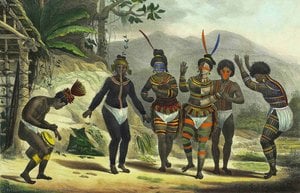
- Brazilian Subject Matter: His time in Brazil led him to focus increasingly on depicting Brazilian landscapes, indigenous peoples, and colonial life.
Notable works by Jean-Baptiste Debret can be found on the WahooArt website, including:
- Sacred Ceremony of D. Pedro 1 ° Emperor of Brazil in Rio de Janeiro 1 ° December 1822 – A detailed lithograph capturing a pivotal moment in Brazilian history.
- Napoléon harangue les troupes bavaroises et wurtembourgeoises à Abensberg, 20 avril 1809 – A powerful depiction of Napoleon addressing troops.
- Indians Crossing A Creek – An example of his detailed depictions of indigenous life.
- Indigenous Population Of Cantagalo, C.1826 – A watercolor showcasing Brazilian culture and landscapes.
Legacy and Later Years
Debret returned to France in 1831 and was elected a member of the Académie des Beaux-Arts. He is perhaps best known for his monumental three-volume series of engravings, Voyage pittoresque et historique au Brésil, published in 1834. This work served as a visual record of Brazilian life during his time there and contributed significantly to European understanding of Brazil. Despite achieving recognition, Debret died poor in Paris in 1848.
- Voyage Pittoresque: His publication remains an invaluable resource for historians and art enthusiasts alike.
- Impact on Brazilian Art Education: Debret’s contributions to arts education in Brazil left a lasting legacy, helping to establish a foundation for the development of Brazilian artistic talent.
For further information on Jean-Baptiste Debret and his work, please visit the WahooArt website or consult Wikipedia's page on the Museu Nacional de Belas Artes.
Questions & Answers
Where are Jean-Baptiste Debret's artworks grouped by art movement?
The movements Jean-Baptiste Debret worked in can be seen on the artist's All Movements page, which groups the artworks by movement.
Where is Jean-Baptiste Debret from?
Jean-Baptiste Debret was born in France.
In which historical period did Jean-Baptiste Debret work?
Jean-Baptiste Debret worked in the Early-Modern period. The period situates the artist's activity in history.