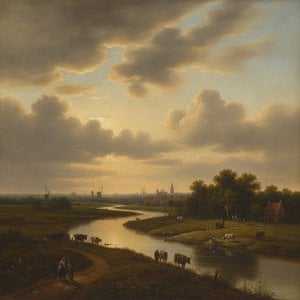
Jan van Mekeren (1658 - 1733): The Silent Maestro of Floral Marquetry
Jan van Mekeren, born in Tiel, Netherlands, in 1658, remains an enigmatic figure within the annals of Dutch Golden Age art. Despite leaving behind a prolific output of cabinetmaker’s creations and paintings—primarily landscapes imbued with atmospheric perspective—scholarly research has yielded scant biographical details about his personal life. He died in Amsterdam in 1733, leaving no surviving family members or extensive correspondence to illuminate his formative years or artistic motivations. This paucity of information contributes to the enduring fascination surrounding his work and its place within the broader context of Baroque aesthetics.- Early Life & Training: Little is known about Mekeren’s early education or apprenticeship. Records indicate he trained as a cabinetmaker in Amsterdam, mastering the intricate techniques required for crafting opulent furniture adorned with elaborate marquetry—a craft that would define his artistic legacy.
- Amsterdam Workshop & Artistic Style: Mekeren established a workshop in Amsterdam where he produced an impressive array of pieces—tables, guéridons, and console cabinets—each showcasing exceptional craftsmanship and breathtaking floral marquetry designs. His style was heavily influenced by the prevailing trends of the period, particularly the fascination with Dutch landscape painting and the masterful use of trompe l'oeil illusionism.
- Landscape Painting: Mekeren’s paintings stand apart from his furniture work in their serene beauty and subtle tonal harmonies. He excelled at capturing the misty landscapes of Holland and Belgium, employing a technique characterized by atmospheric perspective—a deliberate manipulation of color and tone to convey depth and realism—that aligns perfectly with the artistic sensibilities of the Baroque era.
- Notable Works: Among Mekeren’s most celebrated paintings are “The View from Haarlem” (circa 1690-1710), housed in the Rijksmuseum Amsterdam, and “Landscape with Trees” (circa 1695), currently residing in the Kunsthistorisches Museum Vienna. These canvases exemplify his mastery of landscape painting and demonstrate a profound understanding of artistic principles.
- Legacy & Influence: Jan van Mekeren’s contribution to Dutch art history is significant, albeit understated due to the scarcity of biographical information. He represents a pivotal figure in the development of Baroque furniture design and landscape painting—a testament to his skill as a craftsman and artist who captured the essence of his time with remarkable sensitivity and precision.
Floral Marquetry: A Symphony of Color & Illusion
Mekeren’s fame rests primarily on his unparalleled ability to transform plain oak into canvases of exquisite floral marquetry—a technique that elevated furniture design to an art form itself. He achieved this remarkable feat by meticulously inlaying thin veneers of exotic woods—such as holly, barberry, pear, sycamore, padouk, and olive wood—into the oak carcase, creating intricate patterns that mimicked the textures and hues of natural flora. The use of trompe l'oeil carving—a technique designed to deceive the eye into perceiving depth and dimension—further enhanced the visual impact of his creations.- Technique & Materials: Mekeren’s workshop utilized a sophisticated process involving precise cutting, gluing, and polishing of veneers, followed by painstaking inlaying and burnishing to achieve flawless surfaces. The selection of woods was carefully considered, prioritizing those possessing vibrant colors and textural qualities that complemented the floral motifs.
- Floral Motifs & Symbolism: Mekeren’s marquetry designs drew inspiration from Dutch still-life paintings—particularly those produced by Johannes Vermeer and Pieter Claesz.—and incorporated a rich repertoire of botanical symbols imbued with spiritual significance. Tulips, daffodils, anemones, roses, lilies, and other flowers conveyed messages of beauty, fertility, and remembrance—reflecting the prevailing cultural values of the Baroque period.
- Influence on Contemporaries: Mekeren’s innovative approach to marquetry profoundly impacted his fellow craftsmen and artists, establishing him as a benchmark for excellence in furniture design and inspiring subsequent generations to embrace similar stylistic conventions. His work continues to captivate viewers today with its understated elegance and masterful execution.
The View from Haarlem: Atmospheric Perspective & Baroque Landscape
“The View from Haarlem,” painted circa 1690-1710, stands as Mekeren’s most enduring masterpiece—a testament to his mastery of atmospheric perspective and his ability to evoke the sublime grandeur of the Dutch landscape. Executed in muted tones of ochre, umber, and brown, the painting depicts a hazy vista overlooking Haarlem—the provincial capital of North Holland—capturing the misty air and diffused light characteristic of Baroque landscapes.- Composition & Perspective: Mekeren skillfully employed linear perspective to create an illusion of depth—a technique pioneered by Andrea Pozzo and perfected by Rembrandt—drawing viewers’ gaze towards a distant horizon line where the sky merges with the landscape.
- Color Palette & Tone Modulation: The artist meticulously modulated tonal harmonies—shifting hues subtly across the canvas—to convey the atmospheric conditions prevailing at the time of painting. This nuanced approach to color palette aligns perfectly with Baroque aesthetic principles, prioritizing emotional resonance over literal representation.
- Symbolic Significance: While devoid of overt narrative content, “The View from Haarlem” embodies broader symbolic themes—such as contemplation and transcendence—reflecting the spiritual aspirations of the Baroque era. The painting’s serene beauty and understated grandeur continue to inspire admiration for its artistic merit.
Concluding Remarks: An Artist Lost in Time
Despite the absence of biographical details surrounding Jan van Mekeren's life, his legacy as a cabinetmaker and landscape painter remains secure—a testament to his unparalleled skill and unwavering devotion to artistic excellence. His furniture creations exemplify the pinnacle of Baroque craftsmanship—characterized by opulent marquetry designs and meticulous attention to detail—while his paintings embody the sublime grandeur of Dutch landscapes rendered with breathtaking atmospheric perspective. Mekeren’s contribution to Dutch art history deserves recognition as a silent maestro who captured the essence of his time with remarkable sensitivity and precision—a figure whose enduring influence continues to resonate within the realm of Baroque aesthetics.Questions & Answers
How is Jan Van Mekeren's career divided into periods?
The Chronicle of Jan Van Mekeren is a scroll-driven timeline that presents the artist's works in chronological order, grouped into career-period chapters.
How many artworks by Jan Van Mekeren are available to browse?
You can browse 1 artwork by Jan Van Mekeren on the All Artworks page.
In which historical period did Jan Van Mekeren work?
Jan Van Mekeren worked in the Early-Modern period. The period situates the artist's activity in history.