The Intersection of Science and Soul
Jan Antoni Rafalski, born in Poznań, Poland, in 1947, occupies a singular space in the contemporary art world, where the rigorous precision of molecular biology meets the evocative, lyrical beauty of visual expression. His life story is one of profound intellectual duality; he is an artist whose creative vision is deeply informed by a scientific mind. Having pursued advanced studies that led to degrees from Poznań University in Chemistry and a PhD from Yale University, Rafalski brings a unique, analytical depth to his canvases. This academic foundation allows him to approach the canvas not merely as a surface for decoration, but as a laboratory of light, structure, and material truth.
In his work, the boundary between the observer and the observed dissolves. The meticulousness required for scientific inquiry finds its perfect counterpart in his artistic practice, where he explores the subtle interplay of shadow and texture. Unlike many of his contemporaries who may lean toward the abstraction of form, Rafalski remains resolutely anchored in the beauty of representation. He possesses a rare ability to distill the very essence of his subjects, translating the physical properties of matter into a visual language that feels both tangible and transcendent.
The Resonance of the Violin
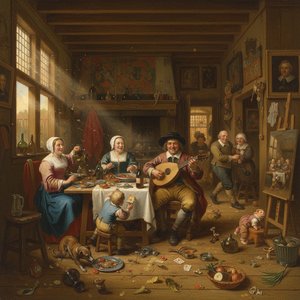
At the heart of Rafalski’s artistic oeuvre lies an enduring fascination with musical instruments, most notably the violin. To Rafalski, the violin is far more than a tool for melody; it is a sculptural marvel of acoustic complexity and structural elegance. His work seeks to document these objects with an unparalleled level of detail, capturing what he perceives as their resonant spirit. Through his paintings, one does not simply see a wooden instrument, but feels the potential energy held within its curves and the history etched into its grain.
His technique is a testament to patience and mastery, characterized by a meticulous layering of glazes and pigments. This painstaking process allows him to replicate the subtle nuances of aged wood, the lustrous sheen of varnish, and the way light dances across a polished surface. His palette is intentionally grounded in the earth, utilizing muted tones such as:
- Ochres that evoke the warmth of aged spruce;
- Siennas and Umbers to provide depth and structural shadow;
- Muted Earth Tones that create a contemplative, timeless atmosphere.
This approach creates a visual experience reminiscent of the Northern Renaissance masters, where every brushstroke serves to honor the inherent dignity of the subject matter.
A Legacy of Observation
The significance of Jan Antoni Rafalski’s contribution to contemporary Polish art lies in his ability to bridge disparate worlds. His career, which included a formative period at DuPont Nemours, has been a continuous journey of honing his observational skills. He does not merely paint what he sees; he paints the structural truth of what he understands through a scientific lens. This marriage of molecular precision and artistic intuition allows him to create works that are both intellectually stimulating and emotionally resonant.
Ultimately, Rafalski’s work stands as a tribute to the beauty of the physical world. Whether he is capturing the intricate construction of a bow or the deep, dark hollow of a violin's body, his art invites the viewer into a state of quiet contemplation. He reminds us that within the most studied and understood objects of our world, there remains an inexhaustible well of mystery and aesthetic wonder, waiting to be rediscovered through the careful gaze of both the scientist and the artist.