James Ramsay (1789–1854): A Pioneer of Newcastle Art
James Ramsay was a British portrait painter born in Newcastle upon Tyne, Northumberland, England, during the Victorian era. His artistic journey began amidst the burgeoning cultural landscape of the Industrial Revolution, shaping his distinctive style and contributing to the rich tapestry of Newcastle’s art scene. While biographical details remain somewhat sparse—a testament perhaps to the challenges faced by artists of his time—Ramsay's legacy endures through his captivating portraits that capture the spirit of their subjects with remarkable precision and sensitivity.- Early Life & Education: Ramsay received his initial artistic training from Thomas Bewick, a celebrated engraver and printmaker whose meticulous attention to detail profoundly influenced Ramsay’s technique. Bewick's influence is evident in Ramsay’s prints alongside his paintings, demonstrating a shared commitment to capturing the nuances of observation.
- Newcastle Art Scene & Patronage: Newcastle during Ramsay’s lifetime was a thriving artistic hub, fueled by coal mining wealth and a growing appreciation for visual arts. He benefited from patronage from prominent families and industrialists, allowing him to produce ambitious commissions that showcased his skill and vision.
Notable Works & Artistic Style
Ramsay’s artistic style is characterized by Neoclassical influences blended with a humanist approach—a hallmark of the era. He excelled at portraying individuals with psychological depth, capturing not merely likeness but also emotion and character. His meticulous brushwork and careful use of color created images imbued with realism and luminosity. Among his most celebrated paintings include “Portrait of Michael Longridge” (1840), a masterful depiction of a gentleman displaying remarkable anatomical accuracy and expressive subtlety—a testament to Ramsay’s dedication to mastering the craft of portraiture. Also, "James Northcote (1746–1831), Aged 78" is another impressive artwork that showcases his talent.- Technique: Ramsay employed oil paints on canvas with painstaking precision, utilizing layering and blending techniques to achieve textures and tonal gradations that conveyed a profound sense of atmosphere. His attention to detail extended beyond mere representation; he sought to convey the inner life of his subjects.
- Influences: Beyond Bewick’s engraving style, Ramsay drew inspiration from classical sculpture and painting—particularly works by Michelangelo and Raphael—which instilled in him an appreciation for idealized form and harmonious composition.
Legacy & Historical Significance
James Ramsay's contribution to Newcastle’s artistic heritage is undeniable. His portraits stand as enduring records of Victorian society, reflecting the values and aspirations of his time. Furthermore, his stylistic innovations—particularly his humanist portrayal of individuals—established him as a pioneer of British portraiture. Today, his paintings reside in museums across Britain, continuing to inspire admiration for their beauty and artistic merit. Ramsay’s work exemplifies the spirit of Newcastle's artistic flourishing during the Victorian period.Questions & Answers
How is James Ramsay's career divided into periods?
A chronological account of James Ramsay's work is available on the artist's Chronicle page, where the artworks pass in order of creation, chapter by chapter.
Where can I see all artworks by James Ramsay?
Every work by James Ramsay on this website can be browsed from the artist's All Artworks page.
Can I visit a virtual museum of James Ramsay's works?
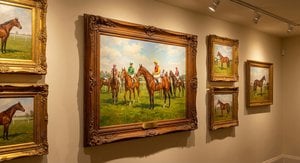
A virtual visit is possible: the 3D Museum page of James Ramsay presents the artist's works in a three-dimensional gallery.