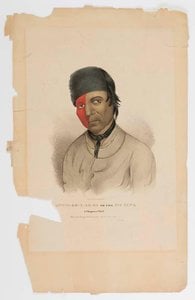
James Otto Lewis: A Pioneer of American Frontier Portraiture
Born in Philadelphia, Pennsylvania, in 1799, James Otto Lewis emerged as a pivotal figure in the visual documentation of America’s westward expansion during the early 19th century. While often operating behind the scenes – rarely credited for his artistic contributions – Lewis’s meticulous engravings and paintings offer an invaluable window into the lives and cultures of Native American tribes and the individuals shaping the burgeoning frontier. His work, primarily housed within the seminal “Aboriginal Portfolio,” transcends mere portraiture; it represents a crucial attempt at ethnographic observation and a complex negotiation between colonial ambition and indigenous sovereignty.
Lewis’s early career began in Philadelphia around 1815 as an engraver, a skill that would prove fundamental to his later work. However, it was his appointment by Governor Lewis Cass of the Michigan Territory in 1819 that propelled him westward. This commission – to paint portraits of Native American leaders and participants in treaty negotiations – marked a turning point, establishing him as a chronicler of a rapidly changing landscape. For nearly fifteen years, from 1823 to 1834, Lewis traveled extensively throughout Indiana and Wisconsin, documenting the intricate political and social dynamics surrounding land acquisition and treaty-making. He wasn’t simply sketching faces; he was capturing moments of power, diplomacy, and cultural exchange – a visual record of a pivotal era in American history.
The Aboriginal Portfolio: A Collaborative Legacy
The “Aboriginal Portfolio,” published between 1835 and 1836, stands as Lewis’s magnum opus. This ambitious project aimed to present a comprehensive depiction of Native American life, customs, and leadership through a series of meticulously engraved plates. While Lewis is often omitted from the official credits for many of these images, his role as the primary artist – and arguably the driving force behind the entire undertaking – is undeniable. The portfolio’s creation was not solely a solitary endeavor; it involved collaboration with figures like Thomas L. McKenney, the Superintendent of Indian Affairs, who provided invaluable insights into tribal politics and cultural context. McKenney's own sketches, particularly those accompanying his tour to the lakes in 1827, are inextricably linked to Lewis’s work, suggesting a shared artistic vision and a deliberate effort to document these events with both visual and textual accuracy.
The portfolio’s production was a protracted process, hampered by financial difficulties. Despite this, it remains a remarkably detailed record of the 1820s treaty negotiations, featuring over eighty plates depicting chiefs, warriors, women, and children from various tribes – including the Winnebago, Chippewa, Pottawatomi, Miami, and others. The sheer volume and detail of these portraits offer an unprecedented glimpse into the lives of Native Americans during a period of profound upheaval and transformation. Notably, later publications like McKenney & Hall’s “History of the Indian Tribes of North America” drew heavily upon Lewis's work, though often attributing the illustrations to Charles Bird King rather than acknowledging Lewis’s crucial contribution.
Technique and Style: A Naturalistic Approach
Lewis’s artistic style is characterized by a remarkable degree of naturalism. His portraits are not idealized representations; they capture subjects with an honesty and immediacy that reflects his presence at the scenes he documented. He employed meticulous detail, carefully rendering facial features, clothing, and accessories to convey both individual identity and tribal affiliation. His work demonstrates a keen eye for observation, capturing subtle expressions and gestures that reveal personality and social standing. The lithographs produced by Lehman & Duval for the portfolio are particularly noteworthy for their clarity and precision, enhancing the impact of Lewis’s original sketches.
It's important to note that Lewis’s work was created during a time when European artistic conventions often prioritized beauty and idealization over accurate representation. His commitment to portraying Native Americans with respect and dignity – albeit through the lens of colonial observation – represents a significant departure from prevailing attitudes. The “Aboriginal Portfolio” can be viewed as both a product of its historical context and a testament to Lewis’s artistic skill and dedication.
Legacy and Historical Significance
Despite his lack of widespread recognition during his lifetime, James Otto Lewis's work holds immense historical significance. The “Aboriginal Portfolio” remains one of the most important visual records of Native American life in the early 19th century. It provides invaluable insights into tribal politics, social customs, and cultural traditions – offering a counterpoint to often biased colonial accounts. His portraits are not merely images; they are historical documents, bearing witness to a period of profound change and conflict. Today, reproductions of these works continue to be studied by historians, anthropologists, and art enthusiasts alike, ensuring that Lewis’s contribution to American visual culture is finally acknowledged and celebrated.
Lewis died in New York City in 1858, leaving behind a legacy as a skilled engraver and a dedicated chronicler of the American frontier. His work serves as a poignant reminder of the complexities of cultural exchange and the importance of preserving diverse perspectives in historical narratives.