Early Life and Artistic Beginnings
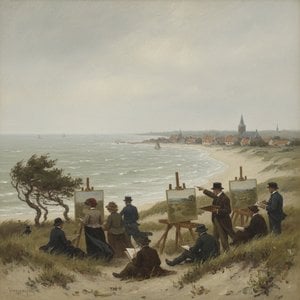
The story of Hans Heys, a name increasingly resonant in contemporary landscape painting, is one rooted deeply in the Dutch tradition yet blossoming into a uniquely personal vision. Born in 1974 in the Netherlands, Heys’s early life was steeped in the visual language of his surroundings – the expansive skies, the intricate network of waterways, and the flat, fertile polders that define much of the country's character. While not formally trained in a classical sense initially, Heys developed an acute observational skill through countless hours spent sketching *en plein air*, capturing the fleeting effects of light and atmosphere. This self-directed education fostered a direct connection to his subject matter, one that would become a hallmark of his mature work. His initial artistic explorations were modest, focusing on local scenes – windmills silhouetted against dramatic sunsets, fields of tulips ablaze with color, and the quiet dignity of traditional Dutch farmhouses. These early paintings, though relatively unassuming, reveal a nascent talent for capturing mood and an instinctive understanding of composition. Heys wasn’t immediately drawn to grand narratives or historical themes; instead, he found beauty in the everyday, imbuing ordinary landscapes with a sense of poetic stillness.Influences and Development
Heys's artistic journey was significantly shaped by his immersion in the Dutch Masters, particularly the 17th-century landscape painters like Jacob van Ruisdael and Aert van der Neer. He admired their masterful rendering of light, their ability to convey depth and atmosphere, and their subtle psychological portrayal of nature. However, Heys wasn’t content with mere imitation. He sought to move beyond the meticulous realism of his predecessors, incorporating elements of Impressionism and Post-Impressionism into his evolving style. The broken brushwork and vibrant color palettes of artists like Monet and Van Gogh resonated deeply with him, inspiring him to experiment with more expressive techniques.- Jacob van Ruisdael: Influenced Heys’s understanding of atmospheric perspective and the depiction of cloud formations.
- Aert van der Neer: Provided a model for capturing the subtle nuances of light in nocturnal scenes and winter landscapes.
- Claude Monet: Inspired Heys’s exploration of broken color and *plein air* painting techniques.
- Vincent van Gogh: Contributed to Heys’s expressive use of brushwork and emotional intensity.
Major Achievements and Artistic Style
Hans Heys has garnered significant recognition for his evocative landscape paintings that seamlessly blend Dutch tradition with contemporary sensibilities. His works are characterized by their atmospheric depth, subtle color harmonies, and poetic stillness. Unlike many contemporary landscape painters who focus on dramatic vistas or remote wilderness areas, Heys finds beauty in the familiar landscapes of the Netherlands – the low-lying fields, the winding rivers, and the ever-changing skies. His signature style is marked by a unique layering technique, where he applies thin washes of color over textured surfaces, creating a luminous quality that captures the fleeting effects of light and atmosphere. He often works in series, revisiting the same locations at different times of day or during different seasons, exploring the subtle variations in mood and character. His paintings are not simply representations of nature; they are emotional responses to it – meditations on time, memory, and the enduring power of the natural world. Recent exhibitions have focused on his “Polder Light” series, which explores the unique quality of light in the Dutch lowlands, and his “River Reflections” series, which captures the shimmering beauty of waterways at dawn and dusk. Heys’s work has been exhibited in galleries throughout Europe and North America, and is held in numerous private and public collections.Historical Significance and Contemporary Relevance
In a contemporary art world often dominated by conceptualism and abstraction, Hans Heys stands out as a dedicated practitioner of landscape painting – a genre that many declared “dead” decades ago. His success demonstrates a renewed appreciation for the beauty and emotional power of representational art. However, Heys is not simply reviving a traditional form; he is reimagining it for a new generation. His work speaks to a growing desire for connection with nature in an increasingly urbanized world. By focusing on the familiar landscapes of his homeland, Heys invites viewers to slow down and appreciate the beauty that surrounds them – to find wonder in the ordinary. His paintings also offer a subtle commentary on environmental issues, reminding us of the fragility and importance of the natural world. Heys’s historical significance lies in his ability to bridge the gap between tradition and innovation, creating works that are both deeply rooted in Dutch artistic heritage and strikingly contemporary in their sensibility. He represents a new wave of landscape painters who are reclaiming the genre, imbuing it with fresh perspectives and emotional depth, ensuring its continued relevance for years to come.Questions & Answers
How many artworks by Jacob Savery are available to browse?
You can browse 7 artworks by Jacob Savery on the All Artworks page.
In which historical period did Jacob Savery work?
Jacob Savery worked in the Renaissance period. The period situates the artist's activity in history.
Can I study Jacob Savery's use of color across all works?
The color profile of Jacob Savery's work is shown on the artist's Palette Genome page.