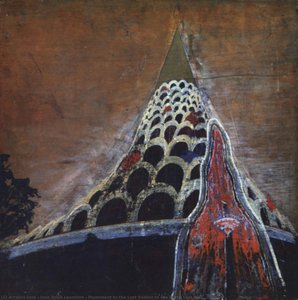
Ivan Ilyich Leonidov: Architect of Unfulfilled Dreams
Ivan Ilyich Leonidov (1902-1959) remains a captivating figure in the annals of Soviet architecture and design, a visionary whose radical ideas and breathtaking sketches were tragically cut short by the constraints of his time. Born in Vladivostok to a farming family, Leonidov’s early life instilled within him a deep connection to the land and a profound appreciation for simple forms – qualities that would later inform his revolutionary approach to urban planning and building design. His journey from a humble farmhand to a prominent architect within the vanguard of Soviet Constructivism is a testament to his innate talent and unwavering commitment to pushing the boundaries of architectural expression.Early Influences and Artistic Beginnings
Leonidov’s artistic path began unexpectedly, with an apprenticeship under an icon painter in his youth. This formative experience provided him with a foundational understanding of composition, color theory, and the power of symbolic imagery – elements that would subtly permeate his later architectural work. He formally pursued his artistic training at Svomas, a progressive art studio in Tver, where he honed his skills as a draughtsman and experimented with various artistic styles. It was during this period that Leonidov’s interest shifted decisively towards architecture, drawn to the potential of design to shape not just buildings but entire urban landscapes. His studies at VKhUTEMAS (Higher Art Technical School), under the tutelage of Alexander Vesnin, proved pivotal, immersing him in the burgeoning world of Constructivism and exposing him to a radical new approach to building – one that prioritized functionality, social utility, and geometric abstraction. Vesnin’s emphasis on “building as an art” profoundly influenced Leonidov's thinking, shaping his belief that architecture could be a powerful tool for creating a better future.The Lenin Institute and the Dawn of a Vision
Leonidov’s most celebrated work, though never realized, is undoubtedly his diploma project for the Lenin Institute and Library in Moscow (1927). This ambitious scheme, a swirling vortex of interconnected spaces designed to foster intellectual exchange and communal living, captured the spirit of Constructivism with its dynamic forms, innovative use of light and space, and emphasis on social interaction. The design featured a central bookstack tower, radiating outwards like the sun’s rays, connected to the city by an elevated monorail – a bold departure from traditional architectural conventions. The project was exhibited at the prestigious Exhibition of Contemporary Architecture in Moscow, instantly catapulting Leonidov into international recognition and cementing his reputation as one of the leading architects of his generation. The design's innovative use of space and its symbolic representation of knowledge and progress resonated deeply with the ideals of the Soviet Union.A Career Shaped by Constraints
Following his diploma project, Leonidov continued to contribute significantly to the development of Soviet architecture, working on a diverse range of projects that reflected his evolving artistic vision. He designed clubhouses, housing complexes, and competition entries for major urban developments, always striving to integrate functional spaces with striking geometric forms. His work as an educator at VKhUTEMAS further solidified his influence, shaping the thinking of a new generation of architects. However, Leonidov’s career was tragically hampered by the shifting political landscape of the Soviet Union. His radical ideas often clashed with the prevailing architectural policies, and his designs were frequently rejected in favor of more pragmatic, utilitarian approaches. Despite these obstacles, he remained committed to exploring new possibilities, sketching elaborate plans for “sun cities” and utopian urban environments – visions that hinted at a deeper understanding of human needs and aspirations.Legacy and Unfulfilled Potential
Ivan Leonidov’s legacy is one of unfulfilled potential—a testament to the tragic intersection of artistic vision and political constraints. While few of his grand designs were ever realized, his sketches, drawings, and theoretical writings continue to inspire architects and urban planners today. His emphasis on spatial dynamism, social interaction, and geometric abstraction remains profoundly relevant in the 21st century. The staircase he designed for the Ordzonikidze Sanatorium in Kislovodsk stands as a poignant reminder of his architectural prowess—a small but significant achievement that embodies his unique aesthetic sensibility. Leonidov’s work serves as a powerful reminder of the importance of artistic freedom and the enduring value of visionary design, even when those visions remain forever trapped on paper. His influence can be seen in the works of later architects who embraced Constructivist principles and sought to create buildings that were both beautiful and functional—buildings that reflected the hopes and dreams of a new era.Questions & Answers
In which movements did Ivan Ilyich Leonidov work?
The movements Ivan Ilyich Leonidov worked in can be seen on the artist's All Movements page, which groups the artworks by movement.
Where are Ivan Ilyich Leonidov's artworks grouped by palette?
Ivan Ilyich Leonidov's works can be browsed by color palette on the artist's By Palettes page.
Where can I see Ivan Ilyich Leonidov's artworks in a 3D gallery?
The 3D Museum of Ivan Ilyich Leonidov is a page that displays the artist's artworks in a virtual three-dimensional gallery.