Jacob van Ruysdael: The Soul of Dutch Landscape
Jacob van Ruysdael (1599 – 1677) stands as one of the most revered figures in Dutch Golden Age art, a painter whose canvases captured not merely visual beauty but also the very essence of the Northern European atmosphere. Born in Naarden, Netherlands—a town nestled between Amsterdam and Haarlem—Ruysdael’s artistic journey began amidst the burgeoning intellectual fervor of his time, mirroring the broader cultural transformation sweeping across Europe. While biographical details remain somewhat sparse due to limited surviving documentation, scholars agree that he honed his craft under the tutelage of Hendrick Avercamp, a fellow landscape painter who instilled in him a profound understanding of tonal painting and compositional balance—principles that would become hallmarks of Ruysdael’s distinctive style.
- Early Life & Training:
- Notable Works:
- Technique & Style:
- Influences & Artistic Legacy:
Notable Works: Echoes of Winter’s Embrace
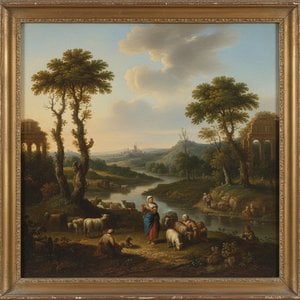
Ruysdael's oeuvre is characterized by an unparalleled sensitivity to light and shadow, a technique he termed “atmosfear,” which elevated landscape painting beyond mere representation. He achieved this remarkable effect through meticulous layering of glazes—thin washes of translucent pigment—creating depth and luminosity that rivaled the finest frescoes. Among his most celebrated paintings are "Winter Landscape with Figures" (1642), housed in Gemäldegalerie Alte Meister Dresden, and “The Shepherdess” (circa 1650), currently residing at Kunsthistorisches Museum Wien. These works exemplify Ruysdael’s masterful command of tonal painting—the deliberate manipulation of color to convey mood and atmosphere—resulting in scenes that evoke a palpable sense of solitude and contemplation. The inclusion of human figures, often rendered with understated realism, serves not merely as decorative element but rather as a conduit for exploring themes of pastoral tranquility and spiritual reflection.
Technique & Style: Mastering Atmosfear
Ruysdael’s artistic innovation stemmed from his pioneering application of atmosfear—a technique that revolutionized landscape painting by prioritizing tonal gradation over precise color accuracy. Unlike many of his contemporaries who adhered to strict color palettes dictated by academic conventions, Ruysdael embraced a muted palette dominated by browns, ochres, and grays, skillfully blending these hues to simulate the subtle variations in light and shade observed in natural environments. This approach demanded considerable patience and precision—a testament to Ruysdael’s meticulous attention to detail—and it enabled him to capture the ethereal quality of winter landscapes with breathtaking realism. Furthermore, his compositional strategies favored asymmetrical arrangements and panoramic vistas, fostering a sense of spaciousness and grandeur that mirrored the vastness of the Dutch countryside.
Influences & Artistic Legacy: Shaping Generations
Ruysdael’s artistic vision was profoundly shaped by influences ranging from Flemish primitives like Pieter Bruegel the Elder to Italian Renaissance masters such as Leonardo da Vinci and Raphael. However, his most enduring legacy resides in his unwavering commitment to capturing the spirit of his time—a period marked by burgeoning scientific inquiry and a renewed appreciation for humanist ideals. Ruysdael’s landscapes served as inspiration for subsequent generations of artists, establishing him as a cornerstone of Dutch landscape painting and cementing his place among the titans of European art history. His influence can be discerned in the works of Rembrandt Harmensz van Rijn, Johannes Vermeer, and countless others who sought to emulate Ruysdael's mastery of tonal painting and atmospheric perspective—a testament to the enduring power of his artistic vision.
- Rembrandt’s Use of Light:
- Vermeer’s Atmospheric Perspective:
Historical Significance: A Reflection of Dutch Identity
Beyond its aesthetic merits, Ruysdael's art embodies the cultural values of the Dutch Golden Age—a period characterized by economic prosperity, intellectual dynamism, and artistic innovation. His landscapes served as visual representations of a nation grappling with questions of faith, morality, and social order, reflecting the anxieties and aspirations of an era undergoing profound transformation. By depicting serene rural scenes populated by humble figures engaged in everyday activities, Ruysdael championed a humanist worldview that prioritized virtue and contemplation—values deeply rooted in Dutch Protestant tradition. Consequently, Ruysdael’s paintings continue to resonate with audiences today, offering insights into the psychological landscape of seventeenth-century Holland and reminding us of the enduring beauty and significance of capturing the sublime grandeur of nature.