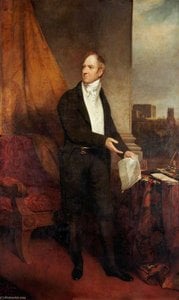
Henry Thomson: The Soul of Silhouette
Henry Thomson (1773–1843) stands as a quietly significant figure in the history of British art, a master of the silhouette portrait and a skilled historical painter whose somber realism resonated deeply with his era. Often overshadowed by more flamboyant contemporaries, Thomson’s enduring legacy lies in his ability to capture profound emotion within meticulously rendered forms – particularly his hauntingly beautiful silhouettes, which remain remarkably evocative today.
Born into a naval family in Portsea, Hampshire, Thomson's early life was shaped by exposure to both the practicalities of seafaring and the artistic sensibilities fostered by his father. This unique blend of influences instilled in him a keen observational eye and a deep appreciation for detail. His formal training at the Royal Academy Schools provided a solid foundation, but it was his time spent traveling with his family through Europe – Italy, Austria, and Germany – that truly ignited his artistic spirit. These journeys exposed him to classical sculpture and architecture, profoundly impacting his understanding of form and composition, and fueling his fascination with historical subjects.
Thomson’s career began modestly, producing portraits and scenes from mythology and literature. However, it was in the early 1800s that he achieved widespread recognition for his silhouette portraits. This technique, popularized by Jean-Baptiste Simeon Chérot in France, involved creating a precise outline of the subject's face and body against a dark background – a process that demanded extraordinary skill and patience. Thomson elevated the silhouette beyond mere technical execution; he imbued each image with an intense sense of melancholy and introspection. His subjects—often members of the aristocracy and gentry—were depicted in moments of quiet contemplation, their faces etched with sadness, loss, or profound inner turmoil. These weren’t celebratory portraits; they were explorations of human vulnerability.
While his silhouette work secured him a place in popular culture, Thomson remained committed to traditional portraiture and historical painting. He produced numerous meticulously researched and executed paintings depicting biblical scenes, classical mythology, and literary figures. His style was characterized by its restrained palette—predominantly muted browns, grays, and blacks—and its emphasis on anatomical accuracy and emotional depth. He drew inspiration from the works of Rembrandt and Caravaggio, mastering their techniques of chiaroscuro (the dramatic use of light and shadow) to create a sense of atmosphere and psychological intensity.
Thomson’s most celebrated historical paintings include “Mercy Interceding for a Fallen Warrior” (1804), a powerful depiction of compassion amidst conflict, and “Love Sheltered” (1806), which captures the poignant beauty of a woman shielding her child from an unseen threat. His work was frequently commissioned by wealthy patrons who sought to adorn their homes with images that reflected their status and values. He also contributed significantly to the burgeoning illustrated book trade, producing detailed engravings for publications such as Sharpe’s *Poets* – a testament to his artistic versatility.
Beyond his artistic achievements, Thomson was also a translator, rendering Antoine-Chrysostome Quatremère de Quincy's philosophical treatise on art into English. This demonstrates a breadth of intellectual curiosity that complemented his artistic pursuits. He served as Keeper of the Royal Academy from 1825 to 1827, a prestigious position reflecting his standing within the British art world. Despite this recognition, Thomson’s health declined in his later years, and he retired to Portsea, where he died in 1843.
Henry Thomson's legacy endures not through grand monuments or widespread fame, but through the haunting beauty of his silhouettes and the profound emotional resonance of his historical paintings. His work offers a poignant glimpse into the anxieties and sensibilities of early 19th-century Britain—a society grappling with social upheaval, industrialization, and a growing awareness of human mortality. Today, Thomson’s portraits continue to captivate viewers with their quiet intensity, reminding us of the enduring power of art to explore the complexities of the human condition.
The Silhouette Technique
Thomson's mastery of the silhouette technique was remarkable, demanding an extraordinary level of precision and sensitivity. The process involved several key steps:
- Initial Sketching: A preliminary charcoal sketch was created to establish the basic composition and proportions of the subject’s face and body.
- Tracing: Using a fine needle and black thread, Thomson meticulously traced the outline of the sketch onto tracing paper. This required immense patience and control, as even slight imperfections could be magnified in the final image.
- Transferring to Black Paper: The traced silhouette was then transferred to a sheet of black paper using a technique involving pricking holes through the tracing paper with a sharp needle.
- Refinement & Detailing: Finally, Thomson would carefully refine the silhouette, adding subtle details such as shading and highlights to enhance its three-dimensionality and expressiveness.
The limitations of the technique—the absence of color and texture—forced Thomson to rely on line weight, contrast, and careful composition to convey emotion and atmosphere. It was this constraint that ultimately contributed to the power and evocative quality of his silhouettes.
Influences and Artistic Connections
Thomson’s artistic development can be traced through a complex interplay of influences. His early exposure to classical sculpture in Italy undoubtedly shaped his understanding of form and anatomy. The works of Rembrandt, particularly his masterful use of chiaroscuro, served as a significant model for Thomson's own approach to lighting and shading. Furthermore, he was influenced by the Neoclassical movement, which emphasized order, reason, and moral virtue – themes that frequently appear in his historical paintings.
He maintained correspondence with other prominent artists of his time, including John Opie and Thomas Lawrence. These exchanges provided him with valuable feedback and insights into contemporary artistic trends. His work was also admired by literary figures such as Letitia Elizabeth Landon, who wrote poems inspired by his portraits.
Historical Significance
Henry Thomson’s contribution to British art lies not only in the quality of his individual works but also in his pioneering role in popularizing the silhouette portrait. Before Thomson, silhouettes were primarily a novelty item produced for the amusement of wealthy patrons. He elevated the technique to an art form, demonstrating its potential for capturing profound emotion and psychological depth.
His somber and introspective style resonated with the anxieties and uncertainties of early 19th-century Britain—a period marked by social unrest, industrialization, and a growing sense of disillusionment. Thomson’s portraits offered viewers a glimpse into the hidden depths of human experience, prompting reflection on themes such as mortality, loss, and the fragility of life.
Questions & Answers
How is Henry Thomson's career divided into periods?
Henry Thomson's career unfolds period by period on the artist's Chronicle page: a horizontal timeline of the artworks, grouped into career-period chapters.
In which historical period did Henry Thomson work?
Henry Thomson worked in the 19th-Century period. The period situates the artist's activity in history.
Can I browse Henry Thomson's works by mood?
The Mood Room of Henry Thomson is a page that arranges the artist's artworks by mood.