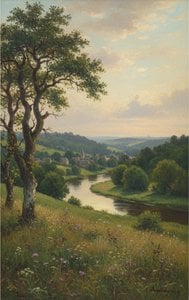
The Visionary Landscapes of Henry Thomas Schafer
In the quiet, evocative landscapes of the late 19th century, few artists captured the profound intersection of nature and emotion as masterfully as Henry Thomas Schafer. Born in Paris in 1873, Schafer emerged as a vital voice within the Romantic movement, a period defined by a deep reverence for the sublime and the untamed beauty of the natural world. His life and work were characterized by an unwavering dedication to translating the ephemeral qualities of light and atmosphere into permanent pigment. Though his career was tragically short, ending with his passing in 1915, he left behind a legacy that continues to resonate through the halls of the Musée Thomas-Henry in Évreux, where his generous bequest transformed a private passion into a public treasure.
Schafer’s artistic journey was deeply rooted in a foundation of classical discipline and familial inspiration. Raised by a father who was a sculptor, he developed an early appreciation for form, structure, and the meticulous craftsmanship required to breathe life into inanimate materials. This technical grounding was further refined at the prestigious École Supérieure des Beaux-als in Paris. Under the tutelage of masters such as Jean Léonard Stammel and Gustave Boulanger, Schafer honed his ability to observe the world with scientific precision while maintaining the emotional depth necessary for Romantic expression. His training allowed him to bridge the gap between rigorous academic realism and the more expressive, atmospheric demands of the burgeoning Romantic aesthetic.
A Symphony of Light and Atmosphere
The true essence of Schafer’s oeuvre lies in his remarkable sensitivity to the interplay of sunlight and shadow. Heavily influenced by the monumental landscapes of Caspar David Friedrich and the emotive power of Eugène Delacroix, Schafer sought to capture more than just a geographical location; he sought to capture a mood. His brushwork often utilized dramatic lighting—a technique known as chiarosc de lumiere—to evoke feelings of melancholy, reverence, or tranquility. Whether rendering the medieval charm of a street in Ratisbon, Bavaria, or the architectural grandeur of the Interior of the Church of St Lawrence in Nuremberg, his work possesses a palpable sense of presence.
His travels and subject matter allowed him to explore a diverse range of European vistas, creating a body of work that feels both intimate and expansive. Notable highlights of his artistic output include:
- The Landscapes of Normandy: Capturing the pastoral serenity and coastal moods of his home region with astonishing accuracy.
- Germanic Cityscapes: Detailed explorations of historical urban environments, such as Ulm, Germany, where he utilized expressive brushwork to depict canals and cathedrals.
- The Sublime and the Pastoral: A recurring theme of balancing the monumental scale of mountains with the quiet, rhythmic beauty of rural life, reminiscent of the influence of Jean-François Millet.
Legacy and Historical Significance
Beyond his technical achievements, Henry Thomas Schafer holds a unique place in art history as a bridge between eras. His work reflects the tension of the late 19th century—a period caught between the traditional values of the past and the rapid industrialization of the future. By focusing on the timelessness of nature and the enduring spirit of historical architecture, he provided a visual sanctuary for those seeking solace in the beauty of the earth. His death in 1915 marked the end of an era, yet his influence persists through the collection he so lovingly established.
Today, Schafer is remembered not only as a painter of landscapes but as a curator of emotion. The Musée Thomas-Henry stands as a living testament to his vision, housing his works alongside masters like Fra Angelico and Filippino Lippi. Through his canvases, such as the hauntingly beautiful At Abbeville, viewers are invited to step into a world where light is a storyteller and every shadow holds a secret, ensuring that the visionary spirit of Henry Thomas Schafer remains eternally vibrant.
Questions & Answers
Where can I find statistics about Henry Thomas Schafer's works?
Statistics about Henry Thomas Schafer's works are available on the artist's Stats page.
Is there a chronological account of Henry Thomas Schafer?
The Chronicle of Henry Thomas Schafer is a scroll-driven timeline that presents the artist's works in chronological order, grouped into career-period chapters.
Where can I see Henry Thomas Schafer's artworks arranged by atmosphere?
The Mood Room of Henry Thomas Schafer is a page that arranges the artist's artworks by mood.