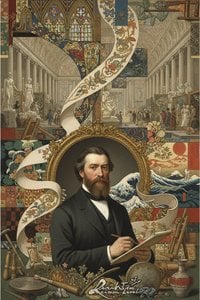
Henry Lerolle: A Parisian Patron and Painter of Mythic Visions
Henry Lerolle (1848-1929) emerged from the vibrant artistic milieu of Paris at a pivotal moment in European art history—the Belle Époque—leaving an indelible mark as both a painter and a fervent supporter of fellow artists, notably Maurice Denis and Vincent van Gogh. His life was interwoven with intellectual curiosity and social engagement, shaping his artistic vision and establishing him as a key figure within the avant-garde movement.
Lerolle’s early training encompassed academic instruction at Académie Suisse alongside Louis Lamothe, grounding him in traditional techniques before he embraced the burgeoning Symbolist aesthetic championed by Denis. This formative influence is evident in his stylistic choices—characterized by meticulous detail, luminous color palettes, and a preoccupation with biblical narratives and mythological themes—reflecting a desire to transcend mere representation and delve into deeper spiritual and emotional resonances. His canvases often depict scenes from antiquity and folklore, imbued with an atmosphere of solemn grandeur and symbolic significance.
A prolific muralist, Lerolle gained renown for his monumental commissions in Paris’s Hôtel de Ville and Sorbonne. The “Crowning of Science” and “Teaching of Science” murals at the Hôtel de Ville powerfully conveyed humanist ideals, mirroring the burgeoning optimism of the era while simultaneously grappling with complex philosophical questions. Similarly, the ceiling fresco depicting "Flight into Egypt" at the Sorbonne showcased Lerolle’s masterful command of perspective and color, establishing him as a leading proponent of Denis's innovative approach to decorative painting—a technique that prioritized emotional impact over literal accuracy.
Beyond his artistic endeavors, Lerolle cultivated relationships with prominent musicians and intellectuals, fostering a collaborative environment that nurtured creativity and intellectual discourse. His friendship with Vincent van Gogh extended beyond mere acquaintance; Lerolle actively encouraged Van Gogh’s artistic explorations and served as a conduit for introducing him to Parisian society. Furthermore, he was instrumental in establishing the École Supérieure des Beaux-Arts, furthering the dissemination of artistic education and fostering the next generation of painters.
Lerolle's legacy resides not only in his impressive oeuvre but also in his role as a catalyst for artistic innovation. He championed Denis’s groundbreaking Symbolist principles—particularly the concept of “decorative painting”—inspiring artists to prioritize expressive qualities over photographic realism. His patronage extended beyond individual artists, encompassing composers and fostering an environment conducive to intellectual exchange. As a result, Henry Lerolle remains recognized as a pivotal figure in shaping the artistic landscape of the Belle Époque and cementing his place within the annals of European art history.