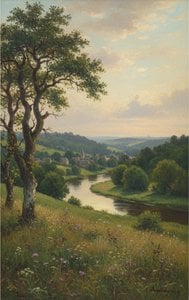
The Ethereal Landscapes of Henry A. Smitheman
In the quiet, mist-laden corners of the English countryside, the legacy of Henry A. Smitheman (1861–1938) lingers like a soft morning fog. A painter who emerged during the twilight of the Victorian era, Smitheman possessed a rare ability to bridge the gap between the fleeting, light-drenched observations of Impressionism and the profound, psychological depths of Symbolism. Born in the historic landscape of Roch Abbey, Yorkshire, his early life was deeply intertwined with the very terrain he would later immortalize on canvas. His formative years at the Kendal Art School, studying under William Joseph Turner II—the son of the legendary Romantic master J.M.W. Turner—provided him with a foundational understanding of tonal mastery and the dramatic potential of the natural world.
Smitheman’s artistic evolution was marked by a transition from the external to the internal. His early explorations were characterized by the plein air tradition, where he sought to capture the immediate sensory impact of light and atmosphere through loose, vibrant brushstrokes. These works celebrated the ephemeral beauty of the British landscape, focusing on the way sunlight dances across meadows or how shadows stretch across a valley at dusk. Yet, as his career matured, his vision transcended mere visual documentation. He began to infuse his landscapes with a symbolic weight, transforming ordinary elements of the rural scenery into vessels for deeper meaning.
A Symbiosis of Light and Soul
To gaze upon a Smitheman landscape is to enter a space of quiet contemplation. He utilized recurring motifs—weathered stone walls, solitary, ancient trees, and undulating misty hills—not merely as subjects, but as conduits for exploring themes of memory, solitude, and the inexorable passage of time. In works such as “Gateway in Roche Abbey, South Yorkshire,” painted in 1910, one can observe his masterful command of texture and depth. The stone archway and surrounding greenery are rendered with an attention to detail that suggests a reverence for the permanence of nature amidst the transient human experience.
His technique often relied on the rich, tactile qualities of oil on canvas, allowing him to build layers of color that mimicked the atmospheric density of the English air. This approach allowed him to achieve a sense of psychological landscape, where the physical environment serves as a mirror to the human spirit. While his contemporaries might have focused solely on the scientific accuracy of light, Smitheman sought the emotional resonance of the scene, creating works that feel less like snapshots and more like echoes of a profound, spiritual connection to the earth.
Legacy and Historical Resonance
Though he remained largely unrecognized by the broader art establishment during his lifetime, the historical significance of Henry A. Smitheman has undergone a poignant revival in recent decades. His ability to synthesize the stylistic innovations of the late 19th century with a deeply personal, symbolic language makes him a vital figure for understanding the transition of British landscape painting into the modern era. His work serves as a bridge between the grand Romanticism of the early 19th century and the more introspective, emotive movements that followed.
Today, his paintings continue to captivate collectors and historians alike, offering a window into a vanished era of rural tranquility. The enduring charm of his oeuvre lies in its ability to evoke a sense of nostalgia—not just for a specific place, but for a way of seeing the world with wonder and reverence. Through his brush, the landscapes of Yorkshire and beyond are transformed into timeless meditations on the beauty and mystery of existence.