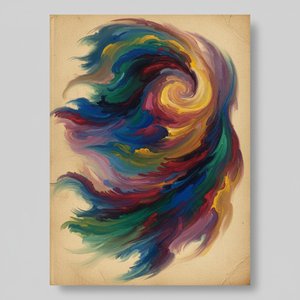
A Pioneer of Color and Form: The Life and Art of Helen Frankenthaler
Helen Frankenthaler, born in 1928 in Manhattan, emerged as a pivotal figure in postwar American painting, bridging the fervent energy of Abstract Expressionism with the serene expanses of Color Field painting. Raised within a progressive Jewish intellectual family – her father a judge, her mother an immigrant from Germany – she was immersed in a world that valued both tradition and innovation. This upbringing fostered a spirit of inquiry that would define her artistic journey. From an early age, Frankenthaler received rigorous art education, studying under Rufino Tamayo at the Dalton School and later honing her skills at Bennington College with Paul Feeley, alongside brief mentorship from Hans Hofmann. These formative experiences laid the groundwork for her groundbreaking explorations in abstraction.
The ‘Soak-Stain’ Revolution
Frankenthaler's most enduring contribution to art history is undoubtedly her development of the “soak-stain” technique in 1952. This revolutionary method involved pouring thinned oil paint directly onto unprimed canvas laid flat on the floor, allowing the pigment to seep into the fabric itself. This was a radical departure from traditional painting practices, which emphasized layering and brushwork. The result was an ethereal quality of translucent color, where forms seemed to float and dissolve within the weave of the canvas. Mountains and Sea, created that same year, is widely considered the seminal work demonstrating this technique – a pivotal moment not only in Frankenthaler’s career but also in the evolution of abstract painting. The painting's expansive washes of color evoked natural landscapes without resorting to representation, hinting at horizons, bodies of water, and geological formations. This innovative approach profoundly influenced artists like Morris Louis and Kenneth Noland, who would go on to become leading figures in the Color Field movement. Frankenthaler didn’t merely paint *on* the canvas; she collaborated with it, allowing the material itself to participate in the creative process.
Expanding Artistic Boundaries
While celebrated for her pioneering work with stain painting, Helen Frankenthaler was an artist of relentless experimentation. In the early 1960s, she embraced acrylic paints, drawn to their brighter hues and ability to create sharper delineations between forms. This shift allowed for a greater degree of control and precision in her compositions. However, her artistic curiosity extended far beyond the confines of painting. Throughout her career, Frankenthaler fearlessly explored diverse media, including ceramics, sculpture, tapestry, and printmaking – particularly woodcuts. She even ventured into theatrical design, creating sets and costumes for the Royal Ballet. This willingness to embrace new challenges underscored her belief that art should be a continuous process of discovery and reinvention. She saw no inherent hierarchy between artistic disciplines, viewing each as offering unique possibilities for expression.
Recognition and Legacy
Frankenthaler’s impact on the art world was recognized early in her career with inclusion in the influential “Fifteen Unknowns” exhibition in 1950 and her first solo show at Tibor de Nagy Gallery in 1951. Major retrospective exhibitions followed, including those at the Jewish Museum (1960), the Whitney Museum of American Art (1969), and a comprehensive traveling retrospective in 1989. In 1966, she represented the United States at the prestigious Venice Biennale, further solidifying her international reputation. Her contributions were formally acknowledged with the National Medal of Arts in 2001. Helen Frankenthaler died in 2011, leaving behind a vast and influential body of work that continues to inspire artists today. The Helen Frankenthaler Foundation, established during her lifetime, remains dedicated to promoting public interest in the visual arts and preserving her artistic legacy. Her paintings are held in major museum collections worldwide, serving as testaments to her enduring vision and innovative spirit. She is remembered not only for her technical innovations but also for her lyrical sensibility – a quality that imbues her abstract compositions with an emotional resonance that transcends stylistic boundaries.