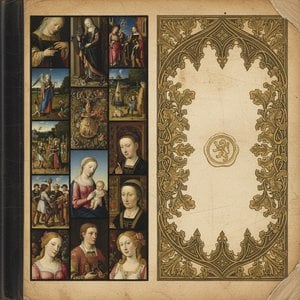
Hans the Elder Schöpfer: A Flemish Renaissance Master in Munich
Hans the Elder Schöpfer (c. 1505 – 1569, München) stands as a pivotal figure in the artistic landscape of the German Renaissance, bridging the gap between Northern European realism and Florentine humanist ideals. Born in Munich, he honed his craft under the tutelage of Wolfgang Mielich, establishing himself as a respected artist within the Bavarian painters’ guild and marking the beginning of a prolific career that would solidify his reputation as one of Bavaria's foremost portraitists.
Schöpfer’s artistic journey commenced in Nuremberg before relocating to Munich around 1520. This move coincided with a burgeoning interest in humanist scholarship and artistic innovation, mirroring the broader trends shaping Europe at the time. His stylistic development can be traced through his early works—particularly portraits of Achaz Busch (1532) and Lady with Parrot (1539)—where he skillfully blended meticulous observation with expressive brushwork, anticipating the techniques championed by Holbein the Younger.
- Early Influences: Schöpfer’s formative years were marked by exposure to the artistic traditions of Nuremberg and Basel, where Mielich practiced. These influences instilled in him a dedication to anatomical accuracy and a nuanced understanding of psychological portraiture—characteristics that would define his distinctive style.
- Munich Patronage: Schöpfer’s residency in Munich brought him into contact with influential patrons, including Maximilian I and Albrecht V., who commissioned numerous portraits reflecting the grandeur and sophistication of the Habsburg court. These commissions allowed him to explore ambitious compositions and experiment with innovative techniques.
- Notable Works: Among his most celebrated achievements are the series of portraits depicting ladies and officials at the ducal court, showcasing Schöpfer’s mastery of color and drapery—elements that contribute to the dramatic impact of these paintings. The Gentleman - Riedler or Schrenk (1532) and Armed Gentleman (Munich, Bayerischen Staatsgemäldesammlungen) exemplify his meticulous attention to detail and psychological insight.
Schöpfer’s legacy extends beyond individual portraits; he played a crucial role in shaping the artistic identity of Munich during its golden age. His work served as inspiration for subsequent generations of artists, establishing him as a cornerstone of Bavarian art history. Today, his paintings reside primarily in Munich museums—including the Lenbachhaus and Bayerisches Nationalmuseum—where they continue to captivate audiences with their timeless beauty and profound psychological depth.
Schöpfer’s artistic output aligns closely with Holbein's style, demonstrating a shared commitment to realism and expressive portraiture. His meticulous rendering of textures and fabrics, combined with subtle gestures conveying emotion, reflects the humanist spirit prevalent in Renaissance art—a testament to Schöpfer’s enduring contribution to European painting.
- The Groeninge Museum: A remarkable collection of Schöpfer's paintings can be found at the Groeninge Museum in Bruges, Belgium. Visitors can admire his masterful depictions of biblical scenes and humanist portraits—a poignant reminder of his artistic versatility and enduring influence.
Hans the Elder Schöpfer’s oeuvre remains a compelling subject for scholarly investigation, offering invaluable insights into the artistic currents of the sixteenth century and illuminating the complexities of Renaissance portraiture. His paintings continue to inspire admiration for their technical brilliance and emotional resonance—solidifying his place as one of Bavaria's most revered artists.