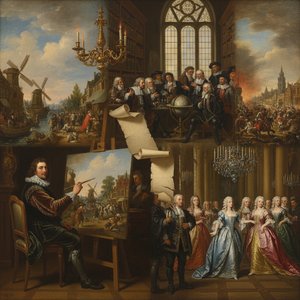
Gerrit Dou: The Master of Subtle Illusions
Gerrit Dou (1613–1675), a name perhaps less familiar than Rembrandt’s, stands as one of the most remarkable and profoundly influential artists of the Dutch Golden Age. Born in Leiden, Netherlands, into a family involved in glassmaking, Dou’s early life was steeped in an appreciation for texture, light, and meticulous craftsmanship – qualities that would fundamentally shape his artistic vision. While he initially apprenticed under Bartholomeus Dolendo, an engraver, it was his time as Rembrandt’s first pupil from 1628 to 1631 that truly ignited his creative fire and established the foundation for his unique style. This formative period instilled in him a deep understanding of chiaroscuro – the dramatic interplay of light and shadow – a technique he would master with unparalleled subtlety and sophistication.
Early Influences and Artistic Development
Dou’s artistic journey wasn't simply a replication of Rembrandt’s style; rather, it was a process of absorbing and transforming his mentor’s lessons into something distinctly his own. Initially, his work mirrored Rembrandt’s dramatic lighting and emotional intensity. However, as he matured and moved away from Leiden, Dou began to develop a more nuanced approach, characterized by an extraordinary attention to detail and a remarkable ability to create the illusion of depth and three-dimensionality on a relatively flat surface. This was partly due to his background in glass engraving – a skill that instilled in him a deep understanding of reflective surfaces and how light interacts with them. He experimented extensively with techniques like *traps*, creating areas of heightened detail that drew the viewer’s eye, while maintaining an overall sense of atmospheric perspective. His early works often featured scenes of everyday life—domestic interiors, portraits, and genre paintings—but it was his later, more complex compositions that truly set him apart.
The Secrets of Dou's Technique
What distinguishes Gerrit Dou’s work is not merely the subject matter but *how* he painted. He employed a painstaking process, often working on multiple layers and using a magnifying glass to achieve incredible precision. He was notoriously fastidious about his materials, demanding the finest pigments and brushes, and meticulously controlling every aspect of his studio environment – avoiding dust and ensuring optimal lighting conditions. This dedication is evident in the almost enamel-like surface quality of many of his paintings, where details appear to shimmer with an inner light. The “traps” he created—small areas of intense detail that seem to leap out at the viewer—are a key element of this illusionistic effect. Furthermore, Dou’s use of *sfumato*, a technique borrowed from Leonardo da Vinci, added to the sense of atmospheric depth and mystery.
Major Works and Historical Significance
Despite his considerable talent, Dou's career was largely overshadowed during his lifetime. His meticulous approach and preference for small-scale works meant that he rarely produced large, grand canvases. However, several paintings have survived to this day, including *The Letter*, *The Musician*, *The Milkmaid*, and *The Young Girl with a Balding Man*. These works exemplify Dou’s mastery of illusionism, his ability to capture fleeting moments of human emotion, and his remarkable technical skill. His influence extended beyond his own lifetime; he was admired by contemporary artists like Jan Lievens and Isaac de Jouderville, who worked alongside him in Rembrandt's studio. In the 19th century, Dou’s work experienced a resurgence of interest, largely due to the efforts of art historians who recognized his unique contribution to Dutch painting. Today, Gerrit Dou is increasingly appreciated as one of the most important and innovative artists of the Dutch Golden Age—a master of subtle illusions whose meticulous technique continues to captivate viewers centuries after his death in 1675.
Legacy and Continuing Appreciation
Gerrit Dou’s legacy lies not only in his individual masterpieces but also in his pioneering approach to illusionistic painting. He demonstrated that it was possible to create a sense of depth, drama, and psychological complexity within a relatively small format. His meticulous technique and innovative use of *traps* influenced generations of artists, and his work continues to be studied and admired by art historians and collectors alike. The National Gallery of Art’s exhibition catalog from 2000 provided a crucial step in reintroducing Dou's work to the wider public, solidifying his place as a significant figure in Dutch Baroque painting.