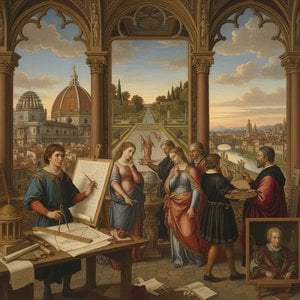
The Illuminating World of Apollonio di Giovanni’s Workshop
Apollonio di Giovanni, though perhaps less celebrated as an individual master than some of his contemporaries, stands as a pivotal figure in the development of early Renaissance illumination. His workshop, active primarily in Florence during the mid-15th century, wasn't merely a place of production; it was a crucible where the Gothic traditions of manuscript painting gracefully yielded to the burgeoning humanist aesthetic that would define the era. While biographical details about Apollonio himself remain somewhat elusive – he appears more as an administrator and orchestrator than a prolific hand in every work attributed to his studio – the sheer volume and quality of manuscripts emerging from his Florentine atelier speak volumes about his artistic vision and organizational skill. He flourished during a period when books were still overwhelmingly produced by hand, making them objects of immense value, luxury, and devotional power. The clientele served by Apollonio’s workshop included prominent families like the Medici, as well as various religious orders, indicating a broad reach and established reputation within Florentine society.
From Gothic Splendor to Renaissance Clarity
The work produced under Apollonio di Giovanni's direction represents a fascinating transition in style. Initially steeped in the International Gothic manner – characterized by elegant figures, rich gold backgrounds, intricate floral motifs, and a delicate, almost ethereal quality – his workshop gradually incorporated elements of the new Renaissance sensibility. This wasn’t an abrupt shift but rather a careful evolution. Early works often feature the elongated proportions and refined drapery typical of Gothic painting, yet even these demonstrate Apollonio's keen eye for composition and color harmony. As commissions evolved, so too did the studio’s approach. We see increasing attention paid to anatomical accuracy, spatial depth (though still relatively shallow compared to later Renaissance masters), and a more naturalistic rendering of figures. The influence of artists like Masaccio and Fra Angelico is palpable in this progression; while Apollonio didn't directly emulate their styles, his workshop absorbed the broader artistic currents shaping Florence.
The gradual introduction of architectural elements within illuminated scenes, for example, reflects a growing interest in perspective and realism.
A Master of Devotional Imagery
Apollonio’s workshop specialized in devotional manuscripts, particularly books of hours – personalized prayer books commissioned by wealthy individuals. These works were not simply religious texts; they were intimate objects designed to facilitate personal piety and reflect the owner's status and taste. The miniatures created within his studio are renowned for their exquisite detail and emotional resonance. Common subjects included scenes from the life of Christ, the Virgin Mary, and various saints.
The Annunciation, a recurring theme in Apollonio’s oeuvre, is often depicted with remarkable tenderness and grace, showcasing the workshop's ability to convey complex theological concepts through visual storytelling. The use of gold leaf was particularly masterful, not merely as decorative embellishment but as a means of creating an otherworldly luminosity that enhanced the spiritual impact of the images. Beyond biblical scenes, his studio also excelled in border decoration – elaborate floral patterns, whimsical creatures, and heraldic symbols that framed the text and added to the overall richness of the manuscript.
The Workshop System and Artistic Collaboration
Understanding Apollonio di Giovanni’s legacy requires acknowledging the collaborative nature of manuscript production during this period. His workshop wasn't a solitary studio but rather a complex organization involving numerous assistants, scribes, and illuminators. While Apollonio likely oversaw all aspects of production – from initial design to final execution – he relied on skilled craftsmen to carry out much of the work. Determining the precise hand of Apollonio himself in specific miniatures remains a challenge for art historians; it’s often more accurate to speak of “the workshop of Apollonio di Giovanni” as a collective artistic entity.
- Scribes meticulously copied the text, often using elaborate calligraphic scripts.
- Gold leafers applied the precious metal, creating shimmering backgrounds and decorative elements.
- Illuminators painted the miniatures, bringing the religious narratives to life.
This division of labor allowed for efficient production while maintaining a consistently high level of quality. The workshop’s success demonstrates Apollonio's ability to manage resources effectively and foster a collaborative environment where artistic talent could flourish.
Historical Significance and Enduring Appeal
Apollonio di Giovanni’s workshop occupies a crucial position in the history of Renaissance art. It represents a vital link between the late Gothic tradition and the fully developed Renaissance style, paving the way for artists like Fra Angelico and Botticelli. His manuscripts offer invaluable insights into the religious beliefs, artistic tastes, and social values of 15th-century Florence.
The meticulous craftsmanship and exquisite beauty of his work continue to captivate audiences today, serving as a testament to the enduring power of illuminated manuscripts. While perhaps not a household name like some of his contemporaries, Apollonio di Giovanni’s legacy lies in the remarkable body of work produced under his direction – a collection that embodies the spirit of transition and innovation that defined the early Renaissance. His influence can be seen in the subsequent development of manuscript illumination throughout Italy and beyond, solidifying his place as a significant figure in the history of art.