The Soulful Vision of Georges van Houten
Born in the sun-drenched atmosphere of Cannes, France, in 1888, Georges van Houten emerged as a painter of profound quietude and psychological depth. A Dutch artist whose life spanned much of the twentieth century, Van Houten possessed a rare ability to bridge the gap between the external world and the internal landscape of his subjects. While he may have remained a figure of more modest recognition during his lifetime, his work resonates with a timeless intensity that speaks to the very essence of the human condition. His artistic journey was not merely a pursuit of aesthetic beauty, but a dedicated exploration of form, light, and the subtle nuances of emotion that define our existence.
The foundations of Van Houten’s mastery were laid at the Koninklijke Academie voor Beeldende Künsten in Antwerp. Under the rigorous guidance of the esteemed Flemish painter Hendrik Willem Bode, the young artist learned to respect the structural integrity of his subjects while simultaneously embracing the expressive potential of color. This training instilled in him a lifelong commitment to meticulous observation. From Bode, he inherited a reverence for the subtle interplay of light and shadow, a technique that would later allow him to breathe life into his portraits and still lifes, making them appear less like static images and more like breathing, pulsing entities.
A Mastery of Light and Texture
Van Houten’s stylistic evolution is a fascinating study in the balance between Impressionistic freedom and classical precision. He was deeply moved by the plein air tradition, often seeking out natural light to capture the fleeting atmospheric shifts of the landscape. However, his approach transcended simple visual documentation. By employing a rich, textured impasto technique, he added a tactile dimension to his canvases. The thick application of paint allowed him to sculpt light itself, creating surfaces that catch the eye and invite a deeper, more visceral engagement with the work.
This technical prowess is most evident in his diverse range of subject matter:
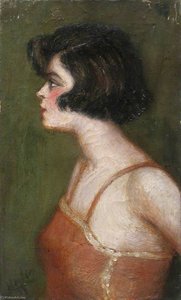
- Intimate Portraits: His portraits are celebrated for their ability to capture the psychological nuance of the sitter, often revealing a hidden vulnerability or a quiet strength behind a steady gaze.
- The Human Form: In his depictions of nudes, such as the evocative Nude, Cannes, Van Houten treats the body with a profound respect, focusing on the grace of anatomy and the soft interplay of light upon skin.
- Still Life and Genre Scenes: Whether painting the simple charm of Rabbit and Carrots or the social elegance of Women Trying on Hats, he infused everyday objects and moments with a sense of narrative importance and dignity.
Legacy and Artistic Significance
The historical significance of Georges van Houten lies in his ability to maintain a sense of intimacy within an era of rapid artistic upheaval. While the art world moved through various stages of abstraction and modernism, Van Houten remained anchored in a tradition that valued the emotional truth found in realism. His work serves as a bridge between the classical Flemish traditions of his training and the expressive liberties of the Impressionist movement.
Today, as scholars and collectors rediscover his oeuvre, Van Houten is recognized not just as a skilled technician, but as a poet of the brush. His paintings offer a sanctuary of stillness in a chaotic world, inviting viewers to pause and contemplate the beauty found in the quiet, often overlooked moments of life. Through his enduring mastery of light, texture, and human emotion, the legacy of Georges van Houten continues to captivate and inspire, ensuring his place in the pantheon of artists who truly saw the soul behind the surface.
Questions & Answers
Can I study Georges Van Houten's use of color across all works?
Georges Van Houten's use of color across the works listed on this website can be studied on the artist's Palette Genome page.
Where can I see Georges Van Houten's artworks in a 3D gallery?
Georges Van Houten's artworks can be seen in a 3D gallery on the artist's 3D Museum page.
Where can I see Georges Van Houten's artworks in chronological order?
Georges Van Houten's artworks can be seen in chronological order on the artist's Artwork Timeline page.