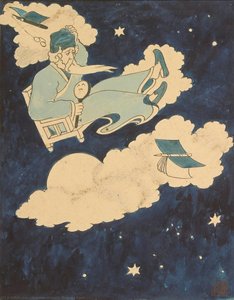
The Vibrant Brushstrokes of a Modern Pioneer
To speak of Gaganendranath Thakur is to invoke a pivotal moment in the narrative of Indian art—a time when tradition met the exhilarating currents of global modernism. Born into the illustrious Tagore family in Jorasanko, India, on September 17, 1867, his life was steeped in an atmosphere where culture, poetry, and artistic endeavor breathed together. He emerged not merely as a painter, but as a vital chronicler of a changing India, possessing a unique ability to capture the ephemeral spirit of daily existence alongside profound mythological moments.
His early years were nurtured within a household renowned for its intellectual and creative fervor, an environment that undoubtedly shaped his artistic sensibilities. While his uncle, Rabindranath Tagore, cast a long shadow as a poet, Gaganendranath carved out his own distinct path. His initial studies in Kolkata laid the groundwork, but it was his subsequent immersion in European art movements that proved to be the catalyst for his mature style.
A Synthesis of East and West in Technique
Gaganendranath Thakur’s artistic vocabulary is a breathtaking tapestry woven from disparate threads. On one hand, the deep resonance of the Bengal School of Art informs his work, grounding it firmly in traditional Indian motifs and techniques. Yet, this foundation was constantly challenged and enriched by influences filtering in from the West—the vibrant immediacy of Impressionism, the emotional depth suggested by Expressionism.
This masterful synthesis allowed him to create a visual language that felt both deeply rooted and startlingly contemporary. His subjects were vast in scope: capturing the quiet dignity of everyday life on the bustling streets, delving into the sublime narratives of Hindu mythology, and paying homage to the enduring beauty of nature. Consider his evocative depictions, such as those portraying pilgrims before the Puri temple or the mesmerizing scene of Sri Chaitanya in a trance at the sea—these works are not mere records; they are meditations rendered visible.
Contributions to India's Artistic Renaissance
His historical significance cannot be overstated. Alongside his brother, Abanindranath Tagore, Gaganendranath played an instrumental role in guiding Indian art through its transition into modernity. He was a crucial bridge builder, adept at integrating sophisticated European techniques without sacrificing the soul of indigenous artistic expression. His use of bold color palettes and expressive brushwork gave rise to a signature style that resonated with both local patrons and international critics.
His satirical cartoons, in particular, reveal an acute social consciousness. They served as witty commentaries on society, giving voice to the burgeoning intellectual discourse of his time. The enduring legacy of his art is visible even today; many of his masterpieces reside within grand institutions like the Victoria Memorial Hall in Kolkata, a testament to their cultural weight.
The Enduring Allure of His Vision
Gaganendranath Thakur’s oeuvre invites us into a dialogue across time. To view his work is to witness an artist who was perpetually looking forward while honoring where he came from. He gifted the modern world a body of art that remains vibrant, witty, and profoundly human—a confluence of spiritual depth and worldly observation, making him an indispensable figure in the canon of Indian Modern Art.
Questions & Answers
In which historical period did Gaganendranath Thakur work?
Gaganendranath Thakur worked in the 19th-Century period. The period situates the artist's activity in history.
Can I browse Gaganendranath Thakur's works by medium?
To find all works by Gaganendranath Thakur in a given medium, use the artist's All Medium page.
Where is Gaganendranath Thakur from?
Gaganendranath Thakur was born in India.