Fritz Eichenberg: A Master of Silent Witness
Fritz Eichenenberg, a name perhaps less familiar than some of his contemporaries, stands as a profoundly significant figure in American illustration and printmaking during the mid-20th century. Born in Cologne, Germany, in 1901, his life was irrevocably shaped by the tumultuous events of World War I and the subsequent rise of Nazism, experiences that fueled a lifelong commitment to social justice and pacifism. Eichenberg’s artistic journey, marked by both technical mastery and deeply felt moral convictions, culminated in a body of work characterized by poignant depictions of religion, war, poverty, and the human condition – works that continue to resonate with their quiet power and enduring relevance.
Early Years & Artistic Training
Eichenberg’s early life was rooted in a traditional German artistic environment. He began his training as a printer's apprentice, developing a fundamental understanding of materials and processes that would later inform his meticulous approach to wood engraving. This practical foundation led him to the Municipal School of Applied Arts in Cologne and subsequently to the Academy of Graphic Arts in Leipzig, where he studied under Hugo Steiner-Prag, a renowned German printmaker. Steiner-Prag’s influence instilled in Eichenberg a deep appreciation for line quality and the expressive potential of woodcut and engraving techniques. Crucially, the devastation wrought by World War I profoundly impacted young Eichenberg's worldview, fostering a strong anti-war sentiment that would permeate much of his subsequent work.
Emigration & The American Years
The rise of Adolf Hitler in 1933 compelled Eichenberg to flee Germany with his wife and daughter. He sought refuge in the United States, settling in New York City and embarking on a new chapter in his artistic career. This emigration marked a turning point, not only for Eichenberg personally but also for his artistic development. In America, he found work as an illustrator for various publications, including newspapers and magazines, often tackling politically charged subjects with unflinching honesty. He joined the Works Progress Administration (WPA), contributing to public art projects during the Depression era, and became a member of the Society of American Graphic Artists. His outspoken political views, coupled with his artistic talent, made him a target for censorship and scrutiny, yet he remained steadfast in his commitment to social commentary.
Technique & Major Works
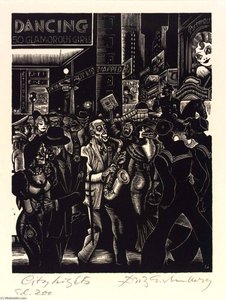
Eichenberg’s signature technique was wood engraving – a demanding process requiring exceptional skill and patience. Unlike woodcut, which relies on carving into the *horizontal* grain of the wood, Eichenberg worked with the *end-grain*, creating incredibly fine lines by carefully incising the surface with a burin. This meticulous approach allowed him to achieve an astonishing level of detail and tonal subtlety, particularly evident in works like “The Subway” (1934), a powerful depiction of urban poverty and alienation, and "City Lights" (1935). His illustrations for books by authors such as Dostoyevsky, Tolstoy, and Brontë demonstrated his ability to capture the emotional depth and psychological complexity of literary narratives. Beyond illustration, Eichenberg produced a series of prints exploring religious themes, notably “The Temptations of St. Anthony” (1966), which showcased his mastery of composition and symbolism.
Legacy & Enduring Significance
Fritz Eichenberg’s artistic legacy extends far beyond the immediate impact of his individual works. He was a crucial voice in American illustration during a period of significant social and political upheaval, using his art to advocate for peace, justice, and human dignity. His commitment to nonviolence and his willingness to confront difficult subjects with honesty and compassion continue to inspire artists today. Eichenberg’s meticulous technique, combined with his profound empathy and moral vision, solidified his place as a key figure in the history of American printmaking – an artist who, through the silent eloquence of his engravings, offered poignant reflections on the human condition.