The Luminous Legacy of Franz Bischoff
Franz Albert Bischoff stands as a quietly influential figure in American art history, a painter whose brush captured the fleeting essence of light and the serene soul of the California landscape. Born in 1864 in Steinschönau am Inn, Austria, his early life was steeped in the rich decorative traditions of the Austro-Hungarian Empire. This foundational training in applied design, watercolor, and ceramic decoration instilled in him a meticulous attention to detail and a profound respect for color harmony. When he emigrated to the United States at the age of fifteen, he carried with him an Old World sensibility that would eventually merge with the burgeoning optimism of the American West, creating a style that was both technically precise and emotionally resonant.
As his career unfolded across the industrial landscapes of New York, Ohio, and Michigan, Bischoff first achieved considerable acclaim through the delicate art of China painting. This discipline required an extraordinary mastery of color blending and fine detail, skills that would later become the hallmark of his landscape compositions. His ability to manipulate subtle glazes and washes allowed him to breathe life into porcelain, a precursor to the ethereal qualities found in his later oil works. It was this unique intersection of decorative precision and atmospheric sensitivity that defined his artistic identity as he transitioned from the meticulous world of ceramics to the expansive vistas of the American frontier.
Impressionism and the California Light
The true metamorphosis of Bischoff’s artistry occurred upon his arrival in California, where the dramatic topography and unique atmospheric conditions provided a new muse. Embracing the tenets of the Impressionist movement, he sought to capture the ephemeral moments of light that define the region. His technique became a sophisticated dialogue between delicate watercolor washes and subtle oil glazes, resulting in canvases that seem to glow from within. He possessed a rare ability to distill complex visual information into harmonious compositions, whether he was depicting the rugged majesty of mountain ranges or the soft, coastal mists of the Pacific.
His oeuvre serves as a vibrant record of the natural world during a transformative era in American history. Through his eyes, we experience the following:
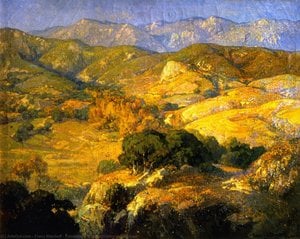
- Cloud Shadows: A 1912 masterpiece where dramatic mountains and vibrant trees are brought to life through an Impressionist lens, offering a serene glimpse into the power of nature.
- Pasadena Foothills: A stunning 1917 oil painting that captures the quintessential beauty of the American landscape, showcasing his ability to render light across rolling terrain.
- Mist-Veiled Days, Monterey: An evocative exploration of the coastal atmosphere, where the interplay of fog and sea demonstrates his mastery of tonal subtlety.
A Lasting Impression on Art History
Beyond the mere depiction of scenery, Bischoff’s work embodies a sense of nostalgia and reverence for the untouched beauty of the landscape. His paintings, such as the masterful Landscape at Saint Valery-sur-Somme, demonstrate an ability to bridge his European roots with his American experiences, blending the structured elegance of his training with the wild, spontaneous energy of the California coast. He did not merely paint what he saw; he painted how the light felt, imbuing his subjects with a sense of peace and permanence.
The historical significance of Franz Bischoff lies in his role as a bridge between the decorative arts and fine art landscape painting. By bringing the meticulousness of China painting to the grand scale of Impressionist oils, he created a niche that was uniquely his own. Today, his works remain cherished for their ability to transport the viewer to a bygone era of discovery and natural splendor, reminding us of the enduring power of a delicate touch and a luminous vision.
Questions & Answers
Is there a complete list of Franz Bischoff's artworks?
Every work by Franz Bischoff on this website can be browsed from the artist's All Artworks page.
Where are Franz Bischoff's artworks mapped by subject?
The Subject Atlas of Franz Bischoff is a page that maps the artist's artworks by their subjects.
Which artworks by Franz Bischoff are the most viewed?
The Stats page of Franz Bischoff presents statistics computed from the artist's artworks listed on this website.
Where is Franz Bischoff from?
Franz Bischoff was born in Austria.
What are the birth city and country of Franz Bischoff?
Franz Bischoff was born in Steinschönau am Inn, in Austria.
Is there a chronological account of Franz Bischoff?
A chronological account of Franz Bischoff's work is available on the artist's Chronicle page, where the artworks pass in order of creation, chapter by chapter.
What are the birthplace and birth year of Franz Bischoff?
Franz Bischoff was born in Steinschönau am Inn in 1864.