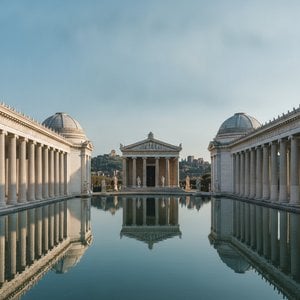
The Neoclassical Vision of François-André Vincent
In the vibrant and turbulent landscape of late eighteenth-century France, few artists captured the transition from aristocratic elegance to revolutionary solemnity as masterfully as François-André Vincent. Born in Paris in 1746 into a lineage of artistic distinction—his father, François-Elie Vincent, was a renowned miniaturist—Vincent was destined for a life defined by the brush and the canvas. His early training under the esteemed Joseph-Marie Vien provided him with a rigorous foundation in the academic tradition, yet it was his innate ability to bridge the gap between the refined grace of the Rococo and the burgeoning discipline of Neoclassicism that would eventually secure his place in art history.
Vincent’s artistic soul was profoundly shaped by his transformative journey to Rome. Upon winning the prestigious Prix de Rome with his commanding work, Germanicus Calms Sedition, he gained unprecedented access to the timeless treasures of classical antiquity. Living and working within the historic Palazzo Mancini, Vincent immersed himself in the study of Raphael and the sculptural precision of ancient masters. This period was not merely an academic exercise but a spiritual awakening; it allowed him to infuse his compositions with a sense of monumental dignity and a harmonious balance that became his hallmark. While he drew deep inspiration from the classical past, he remained acutely aware of the living world around him, often blending historical grandeur with the subtle nuances of contemporary life.
A Master of Portraiture and Historical Narrative
The breadth of Vincent’s oeuvre is a testament to his versatility as a storyteller. He was equally adept at capturing the intimate psychological depth of an individual as he was at depicting the sweeping chaos of historical conflict. In his portraiture, one finds a remarkable ability to convey character through smooth brushstrokes and delicate tonal gradations. His portraits of contemporaries, including the legendary Jean-Honoré Fragonard, reflect a certain dynamism and elegance that suggest a deep connection to the stylistic fluidity of his era. These works serve as windows into the social fabric of pre-revolutionary France, capturing the poise and presence of the era's most notable figures.
However, it was in the realm of history painting where Vincent truly asserted his command over the Neoclassical idiom. His ability to translate complex historical narratives into visually arresting scenes allowed him to participate in the grandest dialogues of his time. A striking example is found in La Bataille des Pyramides, an impressive oil on canvas that commemorates Napoleon's decisive victory in 1798. In this work, Vincent moves away from static composition, instead utilizing loose brushstrokes and earthy tones to evoke the dust, movement, and atmospheric tension of a battlefield set against the backdrop of ancient Egyptian monuments. This capacity to blend the epic scale of history with an almost visceral sense of atmosphere distinguishes him from his more rigid contemporaries.
Legacy and Historical Significance
Throughout his career, Vincent occupied a unique position within the French art hierarchy. Often viewed as a sophisticated rival to Jacques-Louis David, he offered a stylistic alternative that was perhaps less dogmatic and more attuned to the subtle interplay of light and life. While David pushed toward a starker, more austere Neoclassicism, Vincent maintained a connection to the grace and fluidity inherited from his predecessors, creating a bridge between the old world and the new. His contributions to the institutionalization of art were equally significant, as he stood as a founding figure of the Académie des Beaux-Arts, helping to shape the pedagogical standards for generations of French painters.
The enduring legacy of François-André Vincent lies in his ability to harmonize contradictions: the ancient and the modern, the monumental and the intimate, the disciplined and the expressive. His work remains a vital touchstone for understanding the evolution of French art during one of its most transformative epochs. Through his meticulous technique and profound historical insight, Vincent did more than just record history; he breathed life into it, ensuring that the spirit of the Neoclassical era would continue to resonate long after the revolution had passed.
Questions & Answers
How many artworks by François André Vincent are available to browse?
You can browse 45 artworks by François André Vincent on the All Artworks page.
Is there a chronological account of François André Vincent?
François André Vincent's career unfolds period by period on the artist's Chronicle page: a horizontal timeline of the artworks, grouped into career-period chapters.
In which historical period did François André Vincent work?
François André Vincent worked in the Early-Modern period. The period situates the artist's activity in history.