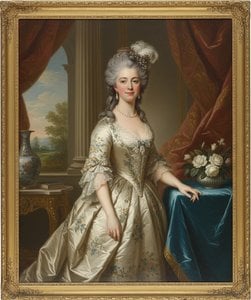
The Dramatic Vision of Francis Hayman
In the vibrant, shifting landscape of eighteenth-century British art, few figures possessed the versatile brilliance of Francis Hayman. Born in Exeter in 1708, Hayman did not merely observe the cultural evolution of his era; he actively shaped its visual language. His journey began far from the refined galleries of London, rooted instead in the ephemeral and high-stakes world of theatrical scenery. This early immersion in the dramatic arts provided him with a unique advantage, instilling a profound understanding of composition, light, and narrative tension that would later define his mastery of the Rococo style. As he transitioned from a scenic painter to an independent artist in St Martin's Lane, Hayman brought with him a storyteller’s soul, capable of transforming a static canvas into a window onto a theatrical moment.
The aesthetic essence of Hayman’s work is deeply intertwined with the Rococo movement, an era characterized by grace, ornament, and a certain lighthearted elegance. Drawing inspiration from the opulent French masters such as François Boucher, Hayman embraced a palette of delicate pastels and fluid, rhythmic brushstrokes. Yet, his work was never purely decorative; it possessed a structural integrity informed by classical ideals. Through his connection to the burgeoning intellectual circles of London, he integrated a sense of proportion and form that allowed his portraits to transcend mere likeness, capturing instead the very essence of character and social standing.
A Legacy of Royal Academy and Narrative Mastery
Hayman’s historical significance is anchored by his foundational role in the establishment of the Royal Academy. As a founding member and the institution's inaugural librarian, he helped lay the groundwork for professional artistic standards in Britain. This position of influence allowed him to bridge the gap between the popular, often boisterous, entertainment of the masses and the high-minded pursuits of the academic elite. His ability to navigate these different worlds is perhaps best seen in his diverse body of work, which ranges from the monumental to the intimate.
His artistic repertoire was remarkably expansive, showcasing a talent that could pivot between genres with seamless ease:
- Theatrical and Literary Scenes: Hayman possessed a rare ability to breathe life into literature, creating evocative depictions of Shakespearean drama and lively scenes from Don Quixote, such as the spirited moment of the innkeeper knighting the knight.
- Portraiture: He became a sought-after chronicler of his age, capturing the charisma of legendary actors like David Garrick and the aristocratic elegance of figures such as Dr. Charles Chauncey, MD.
- Decorative Commissions: His work for the Vauxhall Pleasure Gardens demonstrated his skill in large-scale storytelling, where he used art to enhance the public's sensory experience of leisure and joy.
- Biblical and Mythological Themes: Through works like The Good Samaritan, Hayman utilized his Rococo sensibilities to explore profound themes of compassion, charity, and divine interaction.
Ultimately, the life of Francis Hayman was a testament to the power of visual storytelling. By blending the theatricality of the stage with the refined elegance of the Rococo, he created a body of work that remains a vital window into the Enlightenment era. His legacy persists not only in the canvases that bear his name but in the very structure of British art history, marking him as a true pioneer who helped elevate the status of the painter from craftsman to academic master.
Questions & Answers
Can I browse Francis Hayman's works by movement?
The movements Francis Hayman worked in can be seen on the artist's All Movements page, which groups the artworks by movement.
What are the birth city and country of Francis Hayman?
Francis Hayman was born in Exeter, in United Kingdom.
Where are Francis Hayman's artworks organized by color?
The Spectral Index of Francis Hayman is a page that organizes the artist's artworks by their colors.
What are the birthplace and birth year of Francis Hayman?
Francis Hayman was born in Exeter in 1708.
Where is Francis Hayman from?
Francis Hayman was born in United Kingdom.
In which historical period did Francis Hayman work?
Francis Hayman worked in the Early-Modern period. The period situates the artist's activity in history.
What colors did Francis Hayman use most often?
The color profile of Francis Hayman's work is shown on the artist's Palette Genome page.