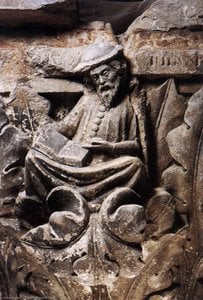
The Architect of Venetian Grandeur
Filippo Calendario stands as a pivotal figure in the artistic landscape of fourteenth-century Venice, primarily recognized for his monumental contributions to the construction and decoration of the Doge’s Palace—a testament to Venetian architectural prowess during its golden age. While biographical details remain scarce due to the limitations of surviving documentation from the period, scholarly research has pieced together a portrait of an artist deeply embedded in the intellectual currents of his time. Born around 1315, likely in Florence, Calendario’s early life was shaped by the rigorous traditions of Italian craftsmanship. He established himself as a skilled mason and architect within the Florentine workshop of Giovanni Pisano, a renowned sculptor and innovator who championed the Gothic style. This formative association instilled in Calendario a profound understanding of structural engineering and decorative artistry, shaping a career trajectory that would eventually redefine the skyline of the Serenissima Republic.
His journey from the workshops of Florence to the lagoons of Venice represents a transformative era in Mediterranean art. Drawn by the burgeoning artistic ambitions of Venice and its ruling authorities, Calendario relocated to the city around 1340. His early presence in official Venetian records reveals a man of practical ingenuity; he was described as a master of small boats used for transporting stone, suggesting that his mastery of architecture was rooted in the very physical labor of construction. This intimate connection to the materials of his craft—the heavy stone and the delicate mortar—allowed him to approach design with a unique perspective on both durability and elegance. As he ascended the ranks of Venetian builders, his work began to reflect the transition toward the iconic Venetian Gothic style, characterized by its ability to harmonize structural necessity with breathtaking ornamentation.
A Legacy Written in Stone and Tragedy
The magnum opus of Filippo Calendario remains inextricably linked to the ambitious rebuilding project of the Doge’s Palace. Commissioned during a period of intense civic pride, this undertaking aimed to transform the palace into an enduring symbol of Venetian grandeur and power. Calendario’s role was both visionary and technical; he oversaw the construction of the palace's eastern facade, contributing to a design that is famously low and squat to accommodate the challenging, marshy ground conditions of the lagoon. His work helped establish a stylistic language that blended the strength of Gothic arches with the light, airy aesthetic required by a maritime empire. Through his meticulous execution, the palace became more than just a seat of government; it became a canvas of political and cultural identity.
However, the narrative of Calendario’s life is as much defined by its tragic conclusion as by its architectural triumphs. The artist's career was cut short by the turbulent politics of the mid-fourteenth century. In 1354, a conspiracy involving Doge Marino Faliero was uncovered, and Calendario was caught in the violent aftermath. Accused of treason, he was sentenced to death alongside the conspirators. On April 16, 1355, in a scene of profound historical irony, Calendario was executed by hanging from the very balcony of the new Palace he had helped create. This sudden end left his architectural projects in a state of transition, with the palace's construction continuing through subsequent phases, yet his influence remained etched into the stone forever. Today, he is remembered not only as a master builder but as a figure whose life and death were woven into the very fabric of Venice itself.