A Hermit of Brittany: The Evocative World of Ferdinand du Puigaudeau
Ferdinand du Puigaudeau, born in Nantes in 1864 and passing away in Croisic in 1930, remains a fascinating figure within the landscape of late 19th and early 20th-century French painting. Though not as widely celebrated as some of his contemporaries, Du Puigaudeau carved out a unique artistic niche, deeply rooted in the traditions and atmosphere of Brittany, and marked by a profound sensitivity to light and shadow. His life was one of both artistic exploration and personal isolation, ultimately earning him the poignant nickname “the hermit of Kervaudu” bestowed upon him by Edgar Degas himself. From his early studies to his final, melancholic works, Du Puigaudeau’s journey reflects a search for authentic expression amidst shifting artistic currents.Early Life and Artistic Formation
Du Puigaudeau's initial exposure to the art world came through his uncle, Henri de Chateaubriant, who actively fostered the young artist’s burgeoning talent. His formal education followed a conventional path, encompassing boarding schools in Paris and Nice, but it was a self-directed exploration of painting that truly ignited his passion. A pivotal trip to Italy in 1882 broadened his horizons, followed by an even more impactful sojourn to Tunisia where he began to develop his own visual language. The year 1886 proved crucial; it marked the first securely dated work and a significant encounter with the artistic community of Pont-Aven. This small Breton village was becoming a magnet for avant-garde painters, including Charles Laval and, most notably, Paul Gauguin. A planned expedition to Panama and Martinique alongside Gauguin never materialized due to Du Puigaudeau’s compulsory military service, yet the brief association left an indelible mark on his artistic trajectory. His early works, exhibited at the Salon of the Société Nationale des Beaux Arts in 1890, began to attract attention, facilitated by introductions from his father to the influential art dealer Paul Durand-Ruel.Pont-Aven and the Breton Spirit
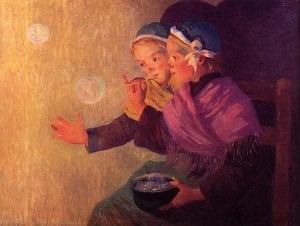
The years spent in Pont-Aven (particularly around 1895) were formative for Du Puigaudeau. He immersed himself in the unique atmosphere of Brittany, captivated by its rugged coastline, ancient traditions, and the deeply spiritual lives of its people. The *pardon*—the traditional Breton religious processions and festivals—became a recurring motif in his work. These events, brimming with vibrant color, fervent devotion, and a sense of communal identity, offered Du Puigaudeau a rich source of inspiration. He wasn’t merely documenting these scenes; he was attempting to capture their emotional essence, the flickering candlelight illuminating faces etched with faith and history. His paintings from this period often depict Breton women, rendered with a quiet dignity and an emphasis on their connection to the land. This focus aligned him with other artists exploring regional identity and folklore, yet Du Puigaudeau’s approach remained distinctly personal—less concerned with social commentary than with evoking a specific mood and atmosphere.Isolation, Financial Struggles, and Late Style
The relationship with Durand-Ruel eventually soured in 1903, leading to financial difficulties that would plague Du Puigaudeau for much of his later life. A visit to Venice in 1904 yielded a substantial body of work, but the economic pressures forced him back to Batz-sur-Mer. In 1907, friends generously provided him with the manor house of Kervaudu in Le Croisic, offering a degree of seclusion that suited his increasingly solitary nature. The outbreak of World War I further intensified his isolation, contributing to a sense of detachment from the wider art world. Despite these hardships, Du Puigaudeau continued to paint, refining his technique and deepening his exploration of light and shadow. His fascination with candlelight studies reached its peak during this period, creating images that are both hauntingly beautiful and deeply introspective.Legacy and Historical Significance
Du Puigaudeau’s artistic journey was marked by a quiet resistance to prevailing trends. While he initially engaged with Impressionism, his work gradually evolved towards a more Symbolist sensibility—less focused on objective representation and more concerned with conveying emotional states and spiritual experiences. His paintings are not grand historical narratives or bold experiments in form; they are intimate portraits of a specific place and people, imbued with a sense of melancholy and reverence. The failed exhibition planned for New York in 1919 was a devastating blow, contributing to his descent into depression and alcoholism. He died in 1930, largely forgotten by the art world. Today, however, Du Puigaudeau is being rediscovered as an important figure in Breton painting, celebrated for his unique vision, evocative brushwork, and profound sensitivity to the nuances of light and atmosphere. His work offers a compelling glimpse into a vanishing way of life, and a testament to the power of art to capture the soul of a place—and the solitude of the artist who sought to understand it.Museum Collections
- Indianapolis Museum of Art, Indiana, USA
- Thyssen-Bornemisza Museum, Madrid (holding “Night Fair at Saint-Pol-de-Leon”, 1894-1898)
- Musée Jacobins, Morlaix, France
- Musée des beaux-Arts, Nantes (featuring “Le Menhir, Pol”)
- Musée des beaux-Arts, Quimper (“Paysage à la chaumière” and “Paysage avec arbres”)
- Musée de Saint Nazaire
- Musée de la Cohue|Musée des beaux-arts in Vannes (“Clair de lune en Brière” and “Office du soir” or “Calvaire de Rochefort-en-Terre”)
Questions & Answers
How is Ferdinand Du Puigaudeau's career divided into periods?
The Chronicle of Ferdinand Du Puigaudeau is a scroll-driven timeline that presents the artist's works in chronological order, grouped into career-period chapters.
What are the birth city and country of Ferdinand Du Puigaudeau?
Ferdinand Du Puigaudeau was born in Nantes, in France.
Can I sort Ferdinand Du Puigaudeau's artworks by color?
The Spectral Index of Ferdinand Du Puigaudeau is a page that organizes the artist's artworks by their colors.