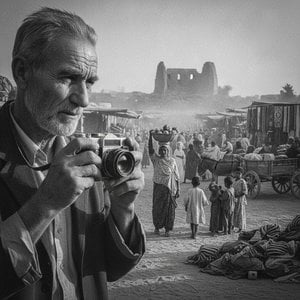
A Visionary Through the Lens: The Legacy of Félix Bonfils
In the golden age of 19th-century exploration, few figures captured the soul of the Orient as intimately or as enduringly as Félix Bonfils. Born in 1831, Bonfils emerged not merely as a photographer, but as a visual chronicler of a world that seemed, to the Western eye, both timeless and exotic. His work, deeply rooted in the tradition of Orientalism, transcends simple documentation; it offers a window into the light, texture, and profound historical weight of the Middle East. Through his lens, the crumbling ruins of ancient civilizations and the vibrant daily rhythms of Levantine life were preserved in silver and shadow, creating a photographic archive that remains indispensable to our understanding of the region's cultural heritage.
The genesis of the Bonfils legacy is inextricably linked to the concept of the Maison Bonfils, a family enterprise that turned photography into a profound artistic and commercial endeavor. Alongside collaborators such as Lydie and Adrien Bonfils, Félix helped establish a studio that functioned as both an artistic workshop and a vital historical repository. His approach was characterized by a meticulous eye for composition and an ability to capture the interplay of light upon desert sands and ancient stone. Whether documenting the monumental scale of the Temple of Bel in Palmyra or the delicate details of local attire, his images possess a narrative depth that invites the viewer to step across the threshold of time.
The Art of Orientalism and Historical Documentation
The work of Félix Bonfils is often categorized within the movement of Orientalism, yet his contribution goes far beyond the mere exoticization of distant lands. While his photographs certainly catered to the 19th-century European fascination with the "mysterious East," they also possess a rigorous documentary quality. His compositions frequently highlight:
- Architectural Grandeur: The sweeping vistas of Islamic architecture and the haunting remains of Roman and Palmyrene ruins, captured with a reverence for their structural majesty.
- Cultural Portraiture: Intimate studies of people, capturing the dignity and character of various ethnic groups through clothing, gesture, and expression.
- Biblical Landscapes: The recreation of scenes that resonated with the religious consciousness of his era, blending historical reality with spiritual imagination.
- Atmospheric Light: A masterful use of natural light to evoke the heat of the desert and the stillness of ancient sanctuaries.
This duality—between the romanticized vision and the ethnographic record—is what gives his oeuvre such lasting power. He did not just photograph landscapes; he photographed the weight of history itself. His ability to frame a ruined temple within its natural, often harsh, environment allowed him to communicate the concept of eternal sites, where the past and present exist in a continuous, breathtaking loop.
A Lasting Impact on Photographic History
The historical significance of Félix Bonfils cannot be overstated. As a pioneer of early photographic processes in the Middle East, he helped lay the groundwork for much of the visual history we possess today. His studio's output became a primary source for scholars, travelers, and artists alike, shaping the Western perception of the Levant for generations. The preservation of his work within institutions like the Médiathèque de l'architecture et du patrimoine photographique ensures that his vision continues to inspire contemporary fascination with the intersection of art, history, and technology.
Ultimately, the life and work of Félix Bonfils represent a bridge between eras. Through his mastery of the medium, he transformed the ephemeral moments of 19th-century life into permanent icons of human achievement and natural beauty. His photographs remain more than mere relics; they are living testimonies to a world of profound complexity, captured by a man who saw the eternal within the transient.