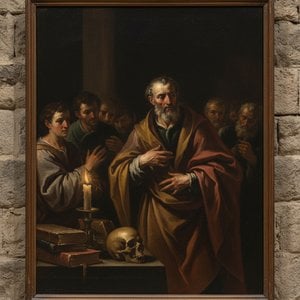
Eugenio Azcue: Bridging Neoclassicism and Romanticism in Spanish Art
Born in Orihuela, Spain, in 1822, Eugenio Azcue emerged as a pivotal figure in 19th-century Spanish painting. His artistic journey represents a fascinating transition point, skillfully weaving together the structured elegance of Neoclassicism with the emotive power of Romanticism. Azcue’s early training at the Academy of San Fernando in Madrid laid a solid foundation in classical techniques and principles. However, his subsequent studies in Rome and Paris exposed him to a broader range of artistic influences, allowing him to refine his style and develop a unique voice that resonated with both historical traditions and burgeoning romantic sensibilities. This period of extensive travel and study proved crucial in shaping the artist’s vision, enabling him to synthesize diverse aesthetic approaches into a cohesive and compelling body of work.
A Devotion to Religious and Historical Narratives
Upon his return to Spain, Azcue dedicated himself primarily to religious scenes and historical figures, demonstrating a profound commitment to depicting narratives that held significant cultural and spiritual weight for the Spanish people. He wasn't merely illustrating stories; he was striving to evoke emotion and convey deeper meaning through his brushstrokes. His commissions included extensive decorative work within several churches in the province of Gipuzkoa, notably at the parroquia de Santa María de Tolosa and the sacristía de Santa María in San Sebastián. These projects showcase Azcue’s mastery of large-scale composition and his ability to integrate painting seamlessly into architectural spaces. The parish in Tolosa, as documented in scholarly research, entrusted him with depicting six walls using Christological and Old Testament themes – a testament to the esteem in which he was held and the breadth of his artistic capabilities. Beyond religious subjects, Azcue also turned his attention to allegorical paintings and portraits, capturing the likenesses of prominent figures from Gipuzkoan society. These portraits weren't simply representations of individuals; they were carefully constructed studies of character and social standing, reflecting a keen observational eye and an understanding of human psychology.
The Synthesis of Styles: A Unique Artistic Voice
What truly distinguishes Azcue is his ability to reconcile seemingly disparate artistic movements. While rooted in the formal precision and clarity characteristic of Neoclassicism – evident in his meticulous attention to detail and balanced compositions – his work also embraces the emotional intensity and dramatic flair associated with Romanticism. This synthesis isn't a mere blending of styles; it’s a creative fusion that results in something entirely new. His religious scenes, for example, are imbued with a sense of reverence and spiritual depth that transcends purely academic representation. The historical figures he portrays aren't static monuments to the past but vibrant individuals brought to life through expressive gestures and nuanced facial expressions. This delicate balance between order and emotion is what makes Azcue’s art so captivating and enduring.
Legacy and Historical Significance
Eugenio Azcue passed away in 1890, leaving behind a significant body of work that continues to be appreciated for its technical skill and artistic vision. While perhaps not as widely recognized as some of his contemporaries, his contribution to Spanish painting is undeniable. He stands as a crucial link between the waning days of Neoclassicism and the rise of Romanticism, demonstrating an ability to adapt and innovate within a rapidly changing artistic landscape. His decorative work in churches remains a testament to his skill as a muralist, while his portraits offer valuable insights into the social fabric of 19th-century Gipuzkoa. Azcue’s legacy lies not only in the beauty of his individual works but also in his role as a bridge between artistic eras, demonstrating the enduring power of art to transcend stylistic boundaries and connect with audiences across generations.