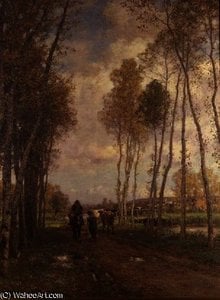
Ernest Albert Waterlow: A Vision of Rural England
Ernest Albert Waterlow (1850-1919) stands as a cornerstone of British landscape painting and a champion of social realism, capturing the essence of rural life in Victorian England with remarkable sensitivity and detail. Born in London to a family steeped in artistic tradition – his father was a sculptor – Waterlow’s early exposure instilled within him a profound appreciation for observation and craftsmanship that would define his entire career.- Early Life & Education: Waterlow received a rigorous education at Marlborough College, fostering a disciplined approach to art and scholarship. He subsequently studied at Slade School of Fine Art in London under Frederic Leighton, absorbing the Beaux Arts ideals prevalent during the period but quickly developing an independent artistic vision.
- Influences: Leighton’s emphasis on classical beauty undoubtedly shaped Waterlow's initial style, yet he soon embraced Impressionistic techniques championed by artists like Claude Monet and Camille Pissarro, recognizing their ability to convey fleeting moments of light and atmosphere. Furthermore, Waterlow was deeply affected by the social realities of his time, particularly the plight of rural laborers and the impact of industrialization on agricultural communities.
The Landscape Painter’s Eye
Waterlow's landscapes are characterized by an unparalleled level of realism—a meticulous attention to detail that renders every blade of grass, ripple of water, and weathered stone with astonishing accuracy. Unlike many of his contemporaries who sought to idealize nature, Waterlow confronted its complexities head-on, depicting scenes of everyday life with unflinching honesty. His canvases are imbued with a palpable sense of place, conveying not merely visual information but also the emotional resonance of the countryside—its tranquility, its hardships, and its enduring beauty. Consider his iconic depiction of “The Old Mill,” commissioned by Worcestershire County Council in 1907; it’s more than just a picturesque view; it's a poignant portrayal of rural industry and the lives of those who toil within it.- Technique: Waterlow employed a layered glazing technique—a painstaking process involving multiple coats of thin washes of color—to achieve luminous effects and subtle tonal variations. He meticulously studied geological formations and plant life, incorporating scientific observation into his artistic practice.
- Notable Landscapes: Among his most celebrated works are “The River Avon,” “The Cotswold Hills,” “The Old Mill,” and “The Shepherdess,” each demonstrating Waterlow’s mastery of landscape painting and his ability to convey profound emotional depth.
Social Consciousness & Artistic Legacy
Waterlow's artistic endeavors extended beyond mere aesthetic pleasure; he possessed a deep concern for social justice and sought to illuminate the lives of ordinary people—particularly those marginalized by poverty and exploitation. He actively campaigned for improved working conditions in rural areas and championed the cause of agricultural reform, reflecting the spirit of Victorian philanthropy and humanist idealism. His paintings served as powerful visual narratives, documenting the realities of rural life and prompting viewers to confront uncomfortable truths about societal inequities.- Social Themes: Waterlow’s artistic output consistently addressed themes of social responsibility and empathy—a rare quality among artists of his era.
- Recognition & Influence: Despite facing considerable criticism during his lifetime for his uncompromising realism, Waterlow garnered posthumous acclaim as a visionary artist who captured the spirit of Victorian England with unparalleled sensitivity and integrity. His influence can be seen in subsequent generations of landscape painters who embraced a similar commitment to observation and social engagement.
A Lasting Impression
Ernest Albert Waterlow’s contribution to British art transcends mere stylistic innovation; he embodies the values of humanist compassion and artistic rigor—qualities that continue to inspire artists today. His landscapes remain treasured representations of rural England, offering a timeless glimpse into the beauty and complexity of the natural world alongside a poignant reminder of humanity's responsibility toward its environment and fellow citizens. He cemented his place in art history as an artist who dared to confront social issues with unflinching honesty while simultaneously achieving unparalleled technical mastery—a legacy that ensures Waterlow’s vision of rural England will endure for centuries to come.Questions & Answers
Is there a complete list of Ernest Albert Waterlow's artworks?
Every work by Ernest Albert Waterlow on this website can be browsed from the artist's All Artworks page.
Where is Ernest Albert Waterlow from?
Ernest Albert Waterlow was born in United Kingdom.
What are the birth city and country of Ernest Albert Waterlow?
Ernest Albert Waterlow was born in London, in United Kingdom.
Can I browse Ernest Albert Waterlow's works by medium?
The All Medium page groups Ernest Albert Waterlow's artworks by technique.
What are the birthplace and birth year of Ernest Albert Waterlow?
Ernest Albert Waterlow was born in London in 1850.
Is there a chronological account of Ernest Albert Waterlow?
Ernest Albert Waterlow's career unfolds period by period on the artist's Chronicle page: a horizontal timeline of the artworks, grouped into career-period chapters.
Where can I find statistics about Ernest Albert Waterlow's works?
A Stats page exists for Ernest Albert Waterlow, presenting statistics about the artist's artworks on this website.