A Brush with the Coast: The Life and Art of Emile Albert Gruppé
Emile Albert Gruppé, born in Rochester, New York, in 1896, wasn’t destined for a life steeped in artistic tradition. His early years were marked by practicality; he initially pursued a career in architecture at the University of Rochester. However, fate – and a burgeoning passion – intervened when he enrolled in classes at the Art Students League of New York around 1920. This pivotal decision set him on a path that would ultimately establish him as a significant figure within the Cape Ann School of painting, capturing the raw beauty and atmospheric nuances of the Massachusetts coastline with remarkable sensitivity. Gruppé’s journey wasn't one of immediate acclaim, but rather a gradual immersion into the techniques and spirit of Impressionism, evolving from architectural precision to a looser, more emotive style that resonated deeply with the New England landscape.
The Allure of Cape Ann and Artistic Development
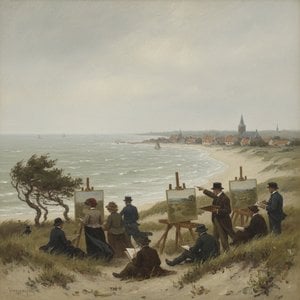
The transformative period in Gruppé’s artistic life began with his first visit to Gloucester, Massachusetts, in 1924. The rugged coastline, the dramatic skies, and the vibrant fishing community immediately captivated him. He quickly became part of a thriving artist colony centered around Rockport, drawn by the same qualities that had attracted earlier generations of painters like Fitz Henry Lane and Winslow Homer. Unlike some who sought to meticulously document reality, Gruppé embraced an Impressionistic approach, focusing on capturing fleeting moments of light and atmosphere. His early works reflect this exploration – studies of boats in the harbor, weathered buildings clinging to the cliffs, and the ever-changing moods of the sea. He wasn’t merely painting *what* he saw, but rather *how* it felt to be present in that environment. This dedication led him to spend nearly every summer on Cape Ann for over fifty years, becoming intimately familiar with its unique character. His technique involved a direct engagement with nature, often working en plein air – directly before his subject matter – allowing the immediacy of observation to inform his brushstrokes and color choices.
Influences and Artistic Style
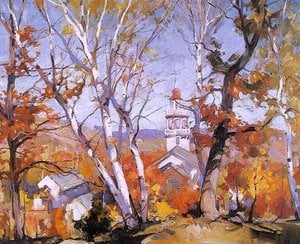
While Gruppé developed a distinctly personal style, he wasn’t immune to the influences surrounding him. The legacy of American Impressionism, particularly the work of Childe Hassam and William Merritt Chase, is evident in his use of broken color and atmospheric perspective. However, Gruppé moved beyond simple imitation, infusing his paintings with a sense of solidity and strength that set them apart. He admired the bold brushwork and expressive palette of European Impressionists like Monet and Sisley, but he tempered their ethereal quality with a more grounded realism rooted in the physicality of the New England landscape.
His work often features a heightened sense of drama, achieved through contrasting light and shadow and a careful orchestration of color. He wasn’t afraid to use darker tones to convey the weight of the sea or the ruggedness of the rocks, creating paintings that are both beautiful and powerfully evocative.
Major Achievements and Recognition
Gruppé's dedication to his craft resulted in a prolific output over several decades. He exhibited widely throughout the United States, gaining recognition for his masterful depictions of coastal scenes. While he never achieved the widespread fame of some of his contemporaries, he was highly respected within artistic circles and enjoyed a loyal following among collectors.
- He became a member of numerous prestigious art organizations, including the Guild of Boston Artists.
- His paintings are held in the permanent collections of major museums across the country, including the Peabody Essex Museum in Salem, Massachusetts.
- Gruppé’s work played a vital role in preserving the artistic legacy of Cape Ann, inspiring generations of painters to follow in his footsteps.
He also taught painting at the Vesper George School of Art in Boston for many years, sharing his knowledge and passion with aspiring artists.
Historical Significance and Enduring Legacy
Emile Albert Gruppé’s significance lies not only in the beauty of his paintings but also in his contribution to the continuation of a uniquely American artistic tradition. He was part of a generation that sought to capture the essence of the natural world, celebrating the beauty of their surroundings with honesty and sensitivity.
His work stands as a testament to the enduring power of Impressionism and its ability to convey both visual reality and emotional experience. As a member of the Cape Ann School, he helped solidify the region’s reputation as a haven for artists, fostering a vibrant creative community that continues to thrive today. Gruppé's paintings offer more than just picturesque views; they provide a glimpse into a specific time and place, capturing the spirit of New England with a depth and authenticity that resonates deeply with viewers even now. He passed away in 1978, leaving behind a rich artistic legacy that continues to inspire and captivate art lovers around the world.