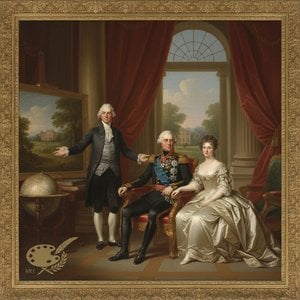
Edward Steel Harper II: Bridging Victorian Realism and Historical Narrative
Edward Steel Harper II (1878-present) stands as a testament to the enduring power of portraiture within the Victorian era, skillfully blending meticulous observation with emotive storytelling. Born in Lyme Regis, Dorset, Harper’s artistic journey unfolded against the backdrop of Britain's burgeoning artistic landscape—a period marked by advancements in Impressionism alongside a steadfast commitment to traditional techniques. His work captures not merely likenesses but profound psychological insight, reflecting his deep understanding of human character and capturing fleeting moments of emotion with remarkable precision.
- Early Life & Artistic Training:
Harper’s formative years were spent honing his artistic skills under the tutelage of Joseph Henry Wilkinson, a celebrated landscape painter who instilled in him a foundational appreciation for tonal harmony and compositional balance—influences that would permeate Harper's subsequent oeuvre. Wilkinson’s emphasis on capturing atmospheric conditions and conveying mood served as an invaluable guide, shaping Harper’s approach to portraying subjects with sensitivity and nuance.
- Notable Commissions & Artistic Style:
Harper gained considerable renown through commissions from prominent families and institutions, securing portraits of figures ranging from industrialists to academics. His distinctive style characterized by a restrained palette—often dominated by muted browns, greys, and ochres—allowed him to prioritize tonal gradation and subtle shading effects. This technique enabled Harper to achieve an unparalleled level of realism, rendering skin textures and drapery folds with astonishing accuracy.
- Key Works & Recurring Themes:
- Guillotine Lock at Lifford: This striking portrait exemplifies Harper’s ability to convey psychological complexity through visual cues. The subject's gaze directs the viewer's attention inward, hinting at unspoken thoughts and emotions—a hallmark of Harper’s artistic vision.
- Prelude, Portrait of a Young Girl: Demonstrating Harper’s mastery of capturing youthful innocence and vulnerability, this piece showcases his meticulous attention to detail and his skillful use of light and shadow to illuminate the subject's countenance.
- Legacy & Influence:
Harper’s legacy extends beyond individual portraits; he championed a humanist aesthetic that prioritized emotional resonance alongside technical virtuosity. His influence can be discerned in subsequent generations of portrait artists who sought to emulate his unwavering dedication to realism and his profound understanding of human psychology—solidifying his place as a pivotal figure within Victorian art history.
Harper’s enduring appeal lies not merely in the visual beauty of his paintings but also in their capacity to evoke empathy and contemplation. He succeeded in transforming static images into windows onto the inner lives of his subjects, leaving behind a body of work that continues to fascinate scholars and art enthusiasts alike.